Login
Login Help Center
 How to get verified

IDV Article
The new era of age verification regulations: How Australia & Malaysia are redefining social media for minors
From cyberbullying to inappropriate content, online risks for young users continue to grow—and regulators are responding. Australia and Malaysia are rolling out some of the world’s most progressive age verification frameworks, aiming to make social platforms safer and more accountable. Their actions could become blueprints for future global standards, signaling a transformative moment for online governance.
The digital landscape is undergoing a major transformation: The new age of age verification regulations. For over a decade, social media platforms focused heavily on user acquisition and engagement. Now, the focus is shifting toward safety and regulation. As we have already discussed in one of our previous articles, governments across the globe are no longer simply encouraging safer online spaces for children. They are demanding them. Businesses in regions like the EU, UKIE, and the United States are already getting ready for these regulatory adjustments.
A significant transformation is also underway across the APAC region, signaling a global shift in progress. They are part of a growing international consensus that the “open door” policy of the early internet is no longer sustainable for minors and their online safety. Recent legislative moves in Australia and Malaysia mark a turning point for the tech industry. These aren’t just suggestions or voluntary guidelines; they are strict legal frameworks with significant financial penalties attached. As Australia enforced a ban on social media for users under 16, and Malaysia announces similar plans for 2026, platforms face an urgent question: How do we verify age accurately without destroying the user experience?
This wave of regulation represents a fundamental change in how the internet operates. For platforms, the era of self-declared birthdays is ending. The era of robust, verifiable age assurance has begun.
Australia sets a strict precedent
Australia has moved faster and more aggressively than almost any other nation. The country’s ban on social media for children under 16 will take full effect on December 10, 2025. This isn’t a theoretical policy; the impact is already visible.
Meta is taking action to remove underage users from its platforms, including Facebook and Instagram. The company is shutting down approximately 450,000 accounts believed to belong to minors, and blocking them from creating new ones.
The Australian government has identified a wide range of platforms that must comply, including TikTok, Snapchat, X (formerly Twitter), Reddit, and Twitch. The stakes for non-compliance are incredibly high, with potential fines reaching $49.5 million for platforms that fail to take “reasonable steps” to exclude underage users.
Communications Minister Anika Wells has been clear about the intent. While acknowledging that no technical solution is perfect, she emphasized that the “age assurance sieve” must start filtering out existing accounts immediately. This puts the burden of proof squarely on tech companies. They must demonstrate they actively prevent access, rather than simply waiting for reports of underage users.
Malaysia joins the movement
Following closely behind Australia, Malaysia has signaled its intention to implement a similar ban. The Malaysian government plans to prohibit social media usage for those under 16 starting in 2026. Communications Minister Fahmi Fadzil explicitly cited the need to protect youth from specific online harms, including cyberbullying, financial scams, and child sexual abuse.
Malaysia is taking a two-pronged approach. In addition to the age ban, they introduced a licensing requirement for any social media or messaging platform with more than 8 million users in the country. This creates a regulatory chokehold in which operational licenses could theoretically be tied to compliance with safety standards.
By reviewing the mechanisms Australia is using, Malaysia is signaling that this is a collaborative global effort. Governments are watching one another, learning what works, and replicating strict legislative models.
How Veriff delivers seamless Age Verification
Modern customers expect a fast, frictionless checkout experience. Any disruption can lead to cart abandonment. This is why a cumbersome age verification process is not an option. Veriff’s solution is designed to integrate seamlessly into your existing user journey, making age checks quick, accurate, and unobtrusive.
Our AI-powered technology works in the background, minimizing friction and keeping the user experience smooth. By using state-of-the-art systems, we can accurately verify a user’s age in seconds, ensuring that legitimate, age-appropriate customers can complete their purchases without unnecessary delays.
Veriff combats these threats through integrated passive liveness detection, which operates invisibly to the user while confirming physical presence. This prevents spoofing with photos, deepfakes, or synthetic identities, ensuring every estimation is authentic, secure, and fraud-resistant.
By merging Age Estimation with liveness detection, Veriff delivers a seamless, low-friction, and tamper-proof verification process—ideal for protecting minors and maintaining regulatory compliance.
Advanced solutions for modern marketplaces
Veriff offers a suite of products designed to meet the diverse needs of online platforms:
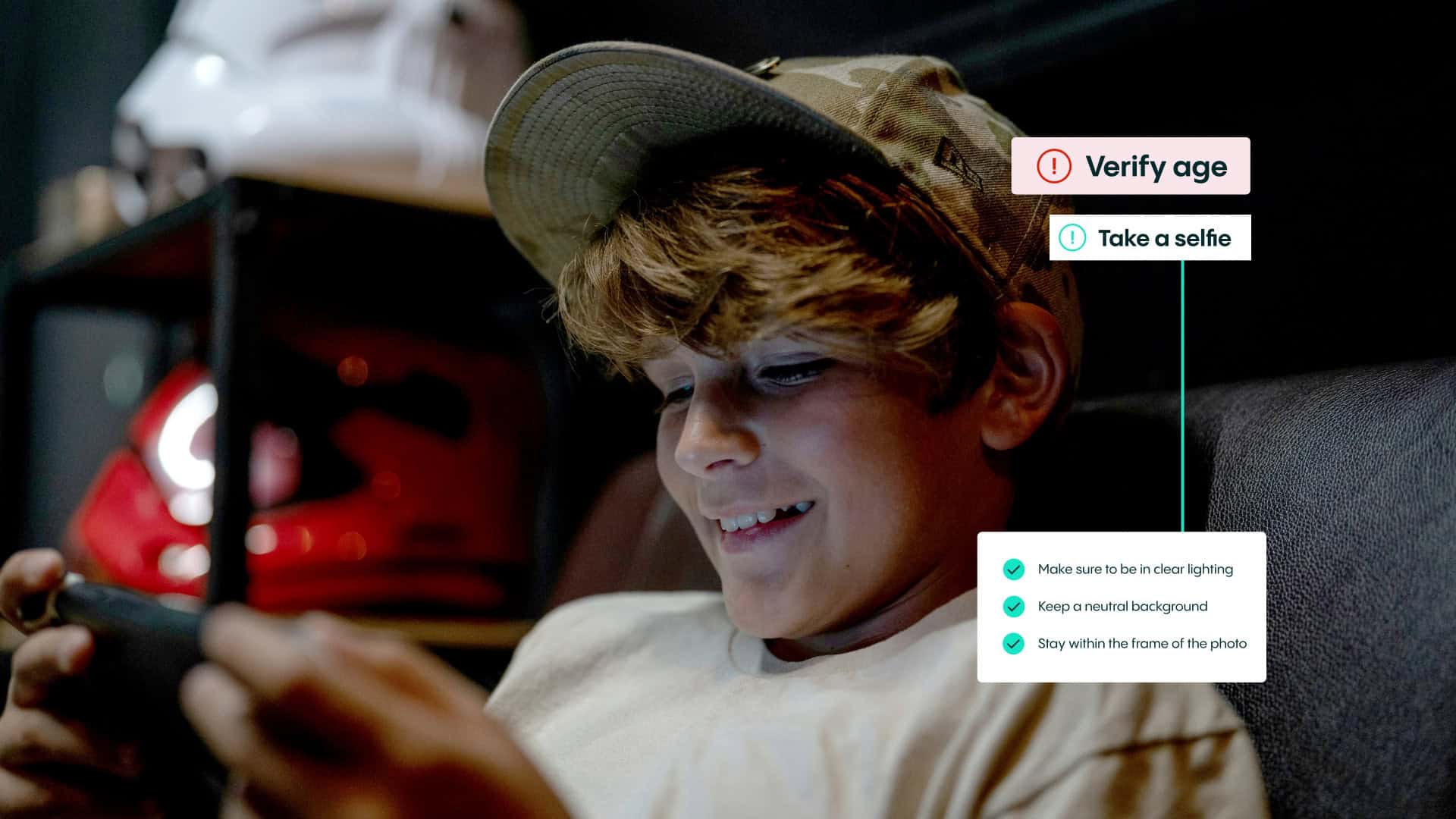
- Age Estimation: This privacy-preserving method uses advanced facial analysis from a simple selfie to estimate a user’s age. It’s a quick, document-free way to ensure users meet a minimum age threshold without collecting sensitive personal data.
- Age Validation: For a more definitive check, our system can extract the date of birth from thousands of government-issued IDs around the world and check against the threshold set. It automatically calculates the user’s age and can decline anyone who falls below your predefined minimum age requirement.

Stay compliant with global age-verification rules.
Protect minors, reduce risk, and meet regulatory requirements effortlessly.
Privacy first
One of the biggest concerns with age verification is privacy. Users are often hesitant to share ID documents with social media apps. Veriff operates with privacy at its core. The data is processed securely, and the goal is verification, not surveillance. Ensuring users that their data is safe is a key part of gaining their trust during the verification process.
The future of online safety
The bans in Australia and Malaysia are likely just the beginning, signaling a wider trend of minor protection in the APAC region. As 2026 approaches, we expect to see more nations adopting similar frameworks. The regulatory net is tightening, and the “Wild West” era of social media is officially over. For tech companies, this is a call to action. Waiting for the legislation to pass before building the infrastructure is a risky strategy. Platforms that proactively integrate robust age verification measures will now be better positioned to navigate the global regulatory landscape. They will not only avoid fines, but also build trust with parents and the public. Ultimately, creating a safer internet for children is a shared responsibility. It requires governments to set the rules, parents to stay involved, and technology providers like Veriff to build the digital gates that keep the wrong users out while letting the right ones in. The message from Canberra and Kuala Lumpur is clear: The safety of young people is non-negotiable. Technology is time to catch up with the policy.