
 Login
Login Help Center
 How to get verified
ON THIS PAGE
March 11, 2026


IDV Article
How Identity Verification creates a competitive advantage for online businesses
In the modern digital landscape, each new user brings a mix of potential and threat. While companies aim to onboard customers smoothly and offer frictionless interactions, they also face the challenge of securing their systems against increasingly advanced fraudulent activities.

In today’s digital economy, trust has become one of the most valuable assets a business can build. Whether launching a new platform or operating globally, users expect fast onboarding, seamless experiences, and strong protection for their personal data.
At the same time, online businesses face a growing challenge: fraud is becoming more sophisticated, while regulatory requirements continue to expand.
Identity verification helps businesses meet these expectations by confirming that users are real, preventing fraud, and creating secure environments where customers can interact with confidence. What was once viewed as a compliance requirement is increasingly becoming a strategic capability that supports growth, global expansion, and long-term customer trust.
Building a competitive advantage through trust
Trust is becoming one of the most powerful differentiators in digital markets.
Research shows 68% of consumers are willing to pay more for products and services from brands they trust, and customers spend up to 51% more with retailers they trust. At the same time, trust can be fragile. PwC’s Voice of the Consumer Survey found that 85% of customers have experienced negative consequences after losing trust in a brand.
For digital platforms, identity verification plays a key role in building this trust foundation. By ensuring that users are genuine and protecting sensitive personal information, businesses create environments where customers feel safe interacting and transacting.
Over time, this trust becomes a meaningful competitive advantage that supports long-term growth.
Avoiding the cost of inaction
Fraud does not only pose a security risk, it also creates significant financial consequences for businesses.
According to the LexisNexis True Cost of Fraud Study, every $1 lost to fraud costs businesses an average of $4.61 when operational costs such as investigations, chargebacks, compliance efforts, and lost productivity are included.
At the same time, fraud pressure continues to rise. More than 60% of ecommerce merchants report increasing fraud levels, and global ecommerce fraud losses are projected to exceed $107 billion annually by 2029.
Research indicates that 43% of cyberattacks target small businesses, making visible security investments not only a protective measure but also a strategic advantage.
These numbers highlight a critical reality: preventing fraudulent users from entering a platform is far more efficient than trying to detect and manage fraud after it occurs.
Investing in strong identity verification early in the user journey helps businesses reduce risk, control operational costs, and protect long-term revenue.
Enhancing the emotional trust factor
Identity verification does more than prevent fraud, it strengthens the overall trust relationship between businesses and their customers.
When users know that a platform actively protects their identities and filters out bad actors, they feel more confident engaging with it. This sense of security encourages deeper participation, whether customers are making purchases, sharing personal information, leaving reviews, or contributing to community features.

Identity verification strengthens trust by ensuring that only legitimate users can access a platform. This helps create safer, more inclusive communities where people feel comfortable interacting, transacting, and building connections.
When users feel confident that a platform prioritizes security, they are more likely to recommend it to others. Strong verification not only deters fraudsters but also attracts genuine users who value safe digital environments, leading to healthier and more engaged communities.
Additionally, verified identities enable businesses to provide faster and more personalized customer support. By quickly confirming user identities, companies can resolve issues efficiently and deliver smoother experiences that build long-term customer loyalty.
Building for the AI fraud surge
While trust and growth are key priorities for online businesses, the threat landscape is evolving rapidly.
According to the 2026 Identity Fraud Report, digitally presented identity media was 300% more likely to be AI-generated or manipulated in 2025 compared with previous years.
Fraudsters increasingly rely on sophisticated techniques such as:
- AI-generated deepfakes
- synthetic identities
- automated bot networks
- manipulated identity documents
These technologies make traditional fraud detection methods significantly less effective.
As Veriff CTO Hubert Behaghel notes, the consequences of identity data exposure often extend far beyond a single platform. Once identity data is leaked, it can be sold and reused across multiple services, creating a cascade of fraud attempts throughout the digital ecosystem. Because of this, businesses must treat identity security as an ongoing process rather than a one-time onboarding check. Advanced identity verification solutions help organizations detect sophisticated fraud while maintaining a seamless user experience.

“Trust in the digital world comes from architecture. It’s about building systems that can verify identity, protect data, and respond to threats at scale.”

Scaling from first user to global enterprise
Online platforms evolve quickly. A startup onboarding its first users today may become a global platform processing thousands of registrations every day tomorrow.
Identity verification supports businesses at every stage of growth.
Early-stage platforms
For startups and early-stage businesses, identity verification helps:
- prevent fraud during early user growth
- automate onboarding with limited resources
- establish trust with customers from day one
Scaling businesses
As platforms grow, identity verification helps companies:
- maintain high conversion rates as traffic increases
- reduce manual review workloads
- expand safely into new markets
Enterprise organizations
At enterprise scale, identity verification supports:
- stopping sophisticated fraud attacks
- managing complex global compliance requirements
- protecting brand reputation across millions of users
Modern identity verification systems scale alongside businesses, evolving from simple onboarding checks into comprehensive trust infrastructure that supports global growth.
Turning Identity Verification into a strategic advantage
Identity verification is no longer just a compliance requirement.
For modern digital platforms, it has become a foundational component of business infrastructure that enables organizations to grow securely and confidently.
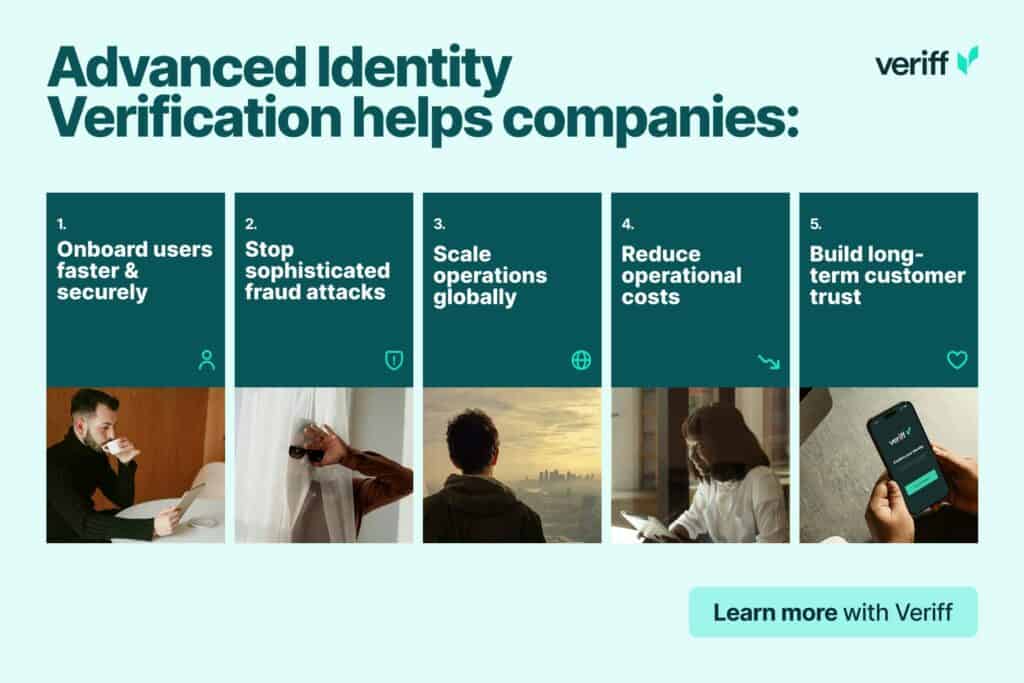
Companies that invest in advanced identity verification can:
- onboard users quickly and securely
- prevent sophisticated fraud attacks
- scale operations globally
- reduce operational costs
- build long-term customer trust
By transforming identity verification from a regulatory obligation into a strategic capability, businesses can create safer platforms, stronger customer relationships, and sustainable growth.
How Veriff protects businesses
Veriff helps businesses build secure and trustworthy digital platforms by combining advanced fraud detection with a seamless user experience. Its AI-powered technology detects fake identities and suspicious activity while allowing legitimate users to verify their identity quickly and easily. With support for global compliance standards such as GDPR,KYC, and AML, Veriff enables companies to operate confidently across multiple markets.
LHV, one of the UK’s newest digital banks, is a great example of how identity verification can support business growth. As an app-based bank in a competitive market, LHV needed to securely onboard new customers while providing a smooth user experience.
By partnering with Veriff, LHV implemented an automated identity verification solution. This system helps prevent fraud and allows legitimate users to verify their identities quickly and easily. This approach enabled LHV to launch with confidence, maintain compliance, and build a digital banking experience on trust and efficiency.
With Veriff, the bank went from concept to launch in under a year, building a fully digital onboarding process. Now, LHV can verify users in about six seconds, allowing customers to open accounts quickly while maintaining high standards for fraud prevention and compliance.

Try for Free
Start your 15-day free trial — No credit card needed.
Explore Veriff’s Self-Serve Plans with Transparent Pricing and Powerful Features.


