Login
Login Help Center
 How to get verified

IDV Article
Age verification in Brazil & Colombia: A 2026 guide
By 2026, age verification will be a compliance must in Latin America. Brazil and Colombia now require digital platforms to implement stricter controls to protect minors, with significant legal and reputational risks for non-compliance. This guide outlines the new regulations, what’s expected, and how to stay compliant without impacting user experience.

Executive summary
Looking ahead to 2026, the regulatory landscape for digital businesses in Latin America is shifting rapidly. This guide breaks down how recent age verification laws in Brazil and Colombia impact online operations, specifically for marketplaces, and adult content providers.
We will synthesize the new legal frameworks, including Brazil’s fresh Digital Statute of Children and Adolescents and Colombia’s pivotal Ley 2489, and outline practical compliance approaches. This analysis offers a forward-looking roadmap for implementing proportionate age verification solutions that satisfy regulators without compromising user experience.
Why age verification is critical in Brazil and Colombia
Age verification has evolved from a simple checkbox to a core compliance requirement. Across Latin America, policymakers are tightening controls to protect minors online and ensure regulated sectors limit access to harmful goods and services. For businesses operating in Brazil and Colombia, age verification is no longer optional, it is a mandatory control that regulators expect to be robust, documented, and auditable.
This shift is driven primarily by new child protection obligations under domestic law. While privacy remains a relevant background consideration, you must handle the data you collect responsibly. The primary driver here is the safety and exclusion of minors from inappropriate digital environments.
For businesses, the challenge is straightforward: meet regulators’ expectations for “reasonable assurance” of age while maintaining a seamless user flow. The strategic approach must be risk-based and capable of withstanding regulatory audits.
Brazil: The new legal standard for age verification
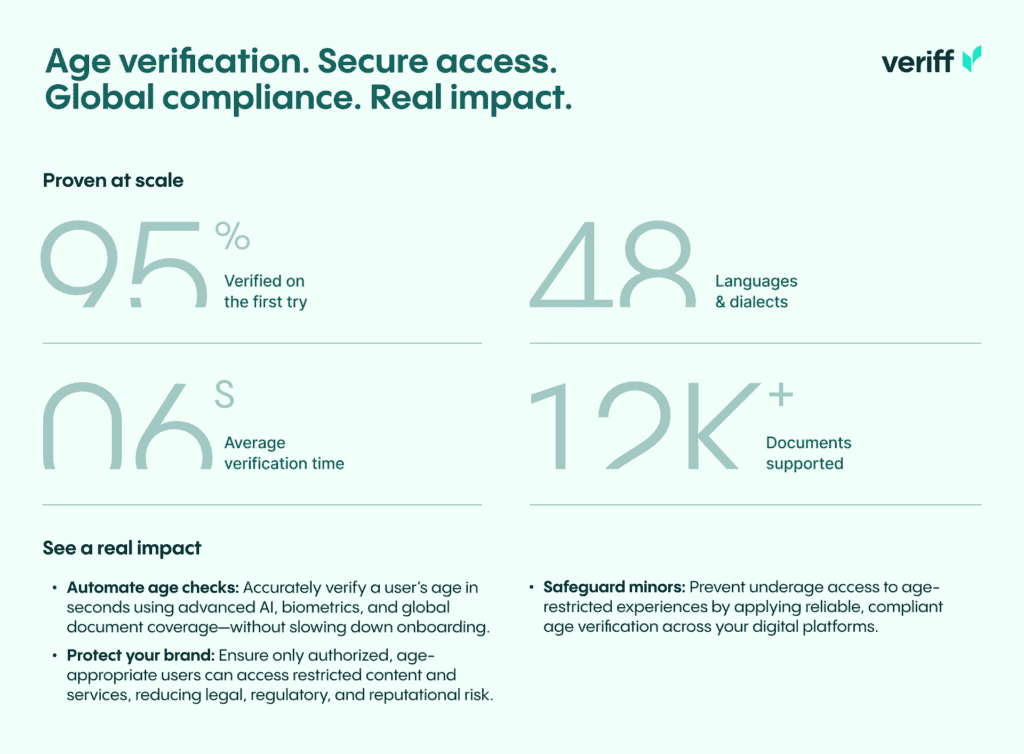
Brazil’s legal architecture for online age verification has recently been fortified. While the General Data Protection Law (LGPD) provides the background rules for data handling, the spotlight is now on specific child protection statutes.
The game-changer: Law 15,211 (2025)
The most critical development is the Digital Statute of Children and Adolescents (Law 15,211 of September 17, 2025). This fresh legislation significantly strengthens protections for minors in digital environments.
Unlike previous general guidelines, this law emphasizes the need for robust, auditable controls to prevent minors from accessing harmful content and services. It moves the needle from passive “terms of service” compliance to active verification. Regulators are expected to use this statute to drive stricter enforcement across all digital sectors. If you are operating in Brazil, this is the law you need to watch.
Other core regulatory drivers
Alongside the new statute, businesses must navigate:
- Estatuto da Criança e do Adolescente (ECA): The foundational law (1990) establishing broad protections, which underpins sectoral restrictions on exposure to harmful content.
- The Internet Civil Framework (Marco Civil da Internet): Sets principles for internet use and safety.
Sector-specific requirements in Brazil
- Marketplaces: Platforms facilitating the sale of regulated goods (alcohol, tobacco, weapons) are expected to implement controls to limit underage access. You may be required to demonstrate the specific steps taken to reduce risky transactions.
- Adult content: Providers distributing sexually explicit content must adopt measures to prevent minors’ access. Simple “I am over 18” buttons are increasingly viewed as insufficient under the new Law 15,211 framework.
Brazil: Looking ahead to 2026
By 2026, we expect Brazilian regulators to enforce higher expectations for “reasonable assurance” of age. There will be far less tolerance for self-declaration alone. Businesses should plan to phase out systems that rely solely on checkboxes and instead adopt layered, risk-based age assurance that provides documented evidence of certainty about a user’s age.
Colombia: Building a framework for safety
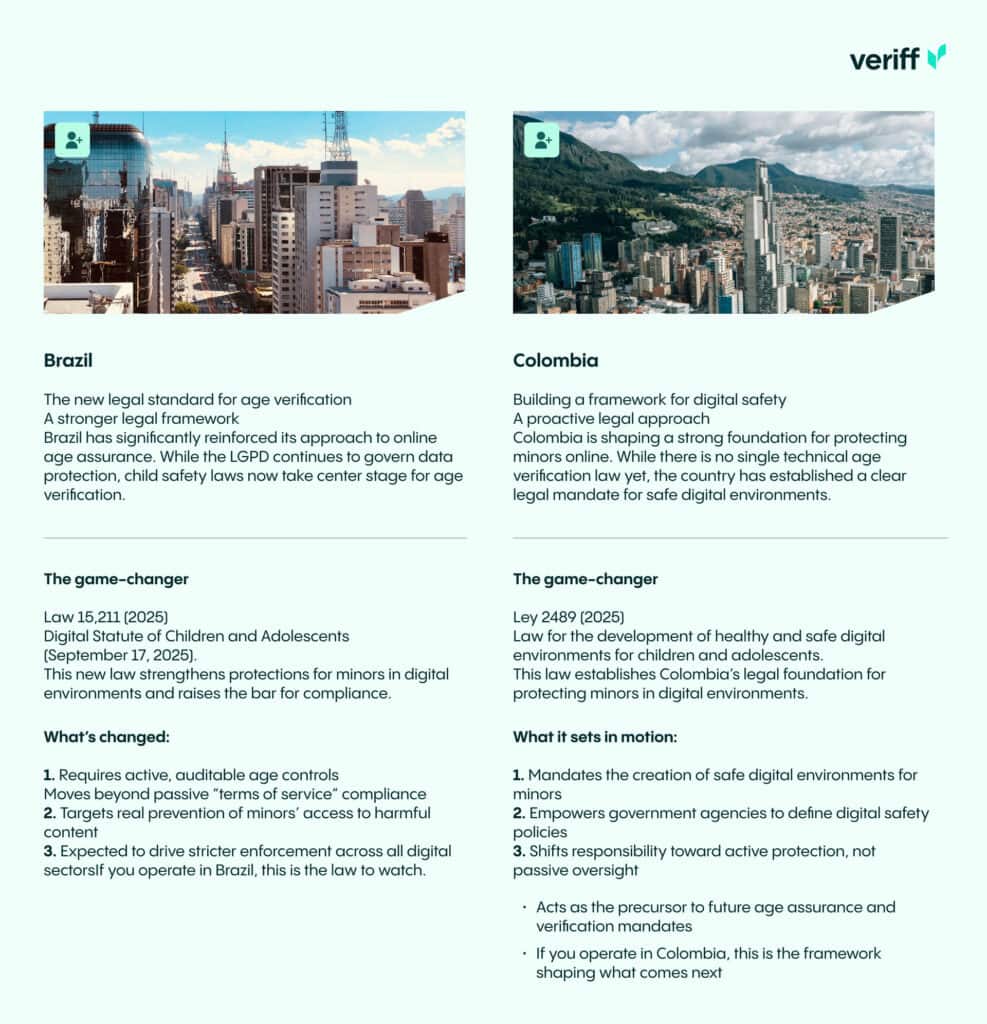
Colombia is taking a distinct approach. While it does not yet have a singular “age verification law” in the traditional sense, it has established a powerful framework that mandates safe environments.
The framework law: Ley 2489 de 2025
The headline legislation is the Law for the Development of Healthy and Safe Digital Environments for Children and Adolescents (Ley 2489 de 2025).
It is crucial to understand that this is not a direct technical mandate for age verification yet, but it creates the legal structure under which governmental agencies must create policies to ensure digital safety. This law is the precursor to future specific mandates. It signals that the Colombian government views digital spaces as areas requiring active protection for minors.
Sector-specific implications in Colombia
- Marketplaces and e-commerce: Those facilitating sales of restricted goods are expected to implement mechanisms to deter underage purchasing. Consumer protection authorities expect demonstrable measures aligned with public safety.
- Content platforms: Providers of adult content are expected to adopt measures that prevent minors’ access, consistent with the country’s child protection obligations.
Colombia: Looking ahead to 2026
The strategic question for 2026 is how to implement age verification that aligns with the spirit of Ley 2489. As agencies begin to issue specific policies under this law, businesses should expect guidance that emphasizes demonstrable risk-based controls. Companies operating in Colombia should prepare for a regulatory environment that prefers controls providing verifiable assurance of age.

Stay compliant with global age-verification rules.
Protect minors, reduce risk, and meet regulatory requirements effortlessly.
Practical guidance for businesses
To comply with these evolving laws, businesses should adopt a pragmatic, risk-based approach.
- Map legal obligations. Identify exactly where your services trigger age limits under the new Brazilian Law 15,211 or Colombian safety regulations. Document these triggers and the specific age thresholds that apply.
- Adopt a tiered verification model. Use low-friction methods for low-risk interactions, but implement higher-assurance checks (document verification, trusted electronic identity) for high-risk transactions like purchasing restricted goods or accessing adult content.
- Document your logic. Regulators want to see your homework. Document why you chose a specific verification method for a specific risk level.
- Audit and test regularly. Maintain auditable logs showing how age was verified for high-risk transactions. Regularly review your false-positive and false-negative rates to ensure you aren’t accidentally allowing minors through or blocking legitimate adults.
- Prepare for privacy as a background requirement. While safety is the primary goal, you must still ensure you aren’t over-collecting data. Only collect the attributes necessary to attest age. If you don’t need to store a user’s full date of birth, don’t.
How Veriff keeps your data safe
Veriff delivers industry-leading age verification solutions by leveraging advanced AI, biometrics, and global document analysis. Our technology ensures that access to restricted content, goods, or services is granted only to age-appropriate users, maintaining full compliance with geo-specific regulations. We provide two robust methods for verification:
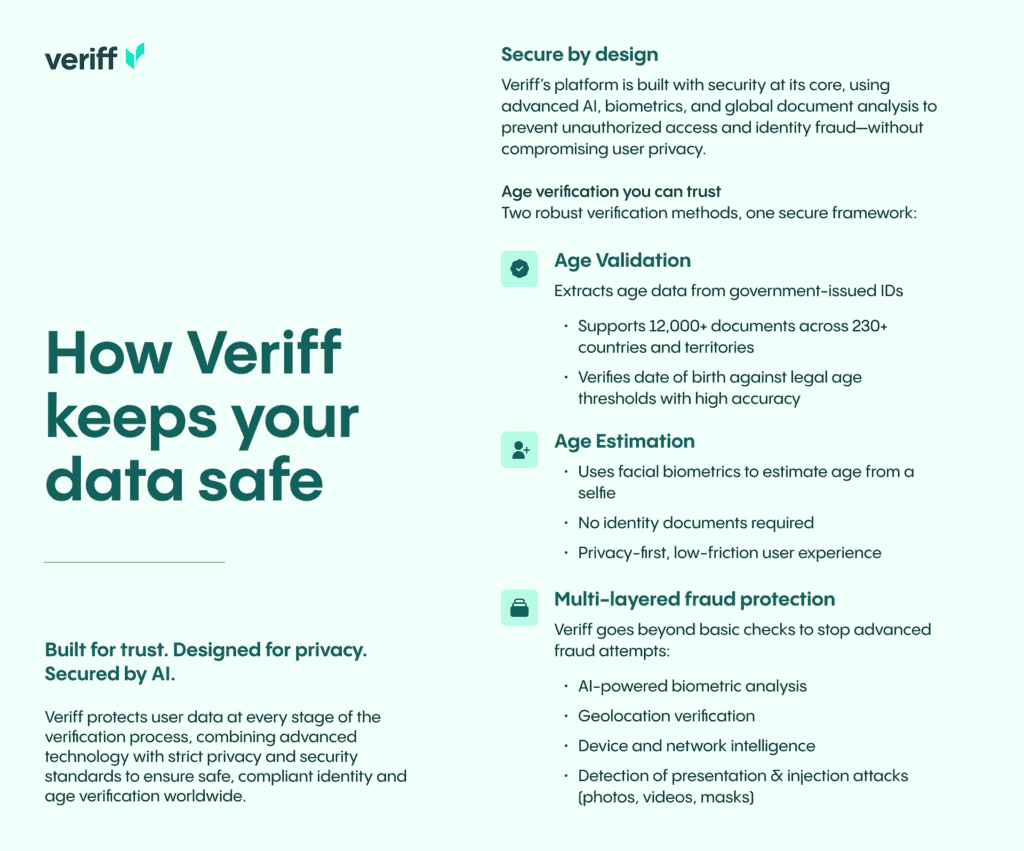
Age Validation: This method utilizes definitive data extraction from government-issued IDs. Supporting over 12,000 documents across 230+ countries and territories, Veriff verifies the date of birth against minimum age thresholds with precision and a minimal margin for error.
Age Estimation: For a low-friction, privacy-centric alternative, our facial biometric analysis estimates a user’s age from a selfie. This eliminates the need for identity documents while ensuring a secure user experience.
To further mitigate risk, Veriff integrates geolocation data and sophisticated device analytics. Our multi-layered security framework effectively identifies and blocks sophisticated fraud attempts, including presentation and injection attacks using photos, videos, or masks. This comprehensive approach ensures both regulatory compliance and the highest standards of digital security.
Conclusion
Age verification laws in Brazil and Colombia represent a broader shift toward active digital responsibility. With Brazil’s Law 15,211 and Colombia’s Ley 2489, regulators are signaling they want auditable controls that protect minors.
Businesses in marketplaces, gaming, and adult content sectors must act now to balance compliance with user experience. A risk-based implementation that documents choices and produces auditable evidence of age assurance will position companies to meet the strict enforcement expectations of 2026.