Login
 Help Center
 How to get verified
October 29, 2026


IDV Article
Digital identity explained: A guide to online security
Your digital identity shapes how you access, verify, and protect yourself online. From logging into accounts to securing transactions, it’s essential in today’s digital world. As cyber threats rise, understanding and safeguarding your digital identity has never been more critical. Let’s explore what it is, why it matters, and how to protect it.
McKinsey’s article on digital identity begins with a thought-provoking question:
What would you do if you had a copy of yourself? A digital doppelgänger, identical to you in every way, in an accurate digital rendering of your home, workplace, neighborhood, or city? Even better: What if the digital version of you, your digital twin, was impervious to injury, pain, or embarrassment? The mind boggles at the possibilities. Suffice it to say, you’d probably be able to make decisions for yourself with a lot more certainty of the outcome.
While this idea may sound futuristic, aspects of it are already shaping the way we interact online. Every time you log in to an account, verify your identity, or complete a digital transaction, you’re engaging with your digital identity, a virtual representation of who you are. But what exactly does that entail, and why is it so crucial in today’s interconnected world?
What is digital identity
In an increasingly digital-first society, digital identity is the foundation for secure interactions, transactions, and access to online services. A digital identity is a collection of electronically stored information that represents an individual, organization, or device in the digital world.
This includes personal data, biometric identifiers, online credentials, and authentication methods that verify your identity when accessing digital services.
These digital identifiers are the data points that banks, government agencies, and online services check before they let consumers or businesses access online services, whether that means logging in to an existing account or opening a bank account. No single document holds a person’s digital identity. It is a set of digital identity data that, taken together, confirms who you are. The related terms digital ID and digital identification usually refer to the government-issued version, such as a mobile driver’s license or a national digital identity card.
Core components of digital identity
A digital identity is made up of different types of information and signals that help establish who a person is, verify their identity, and assess whether their online interactions are trustworthy.
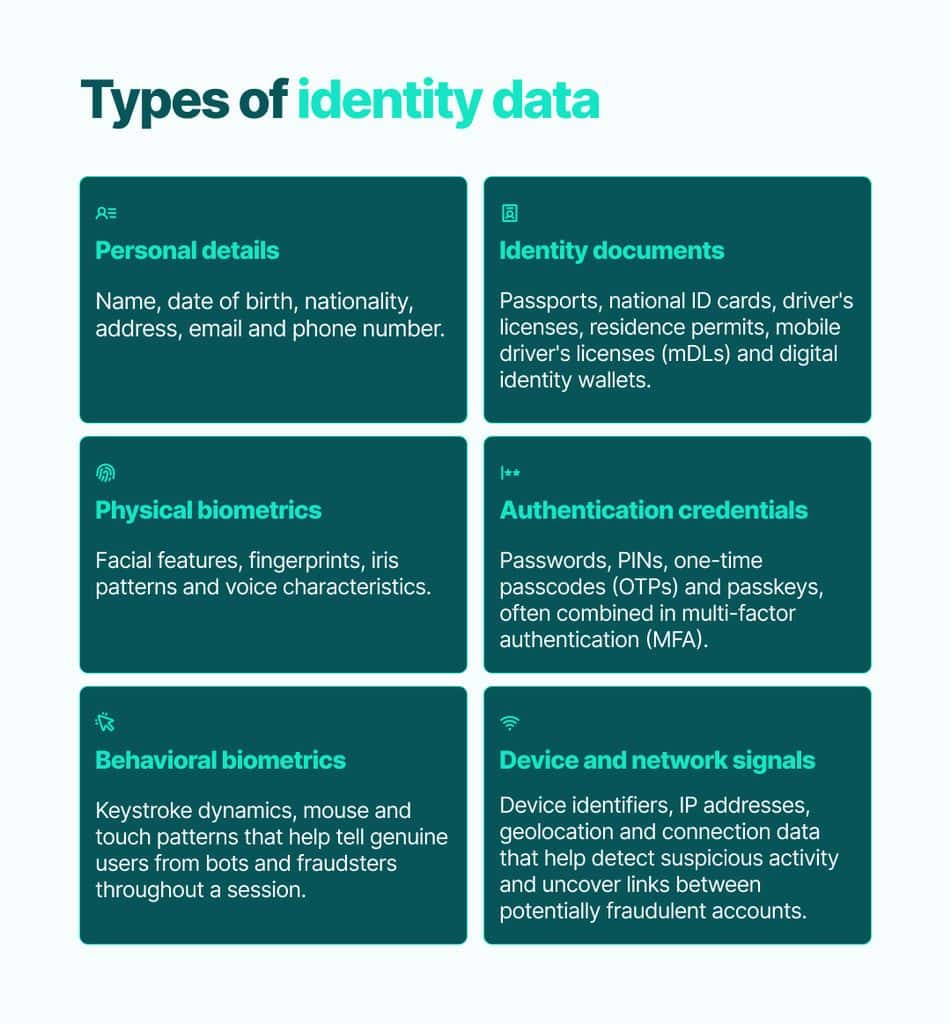
It can include personal data, such as a person’s name, date of birth, citizenship, place of birth and address, alongside identity documents and credentials that provide official evidence of these details. These range from physical documents, such as passports and ID cards, to digital credentials, such as mobile driver’s licenses (mDLs) and the EU Digital Identity Wallet. Digital credentials can enable instant verification and selective disclosure, allowing someone to prove they are over 18, for example, without revealing their exact date of birth.
Physical biometrics add another layer by using measurable characteristics of the human body, including fingerprints, facial features, iris and retina patterns, palm and vein patterns, hand geometry and voice. Because many of these traits are distinctive and relatively stable over time, they can help confirm that a person is who they claim to be. For example, facial recognition can compare a live selfie with the photograph on an identity document to establish whether they belong to the same person.
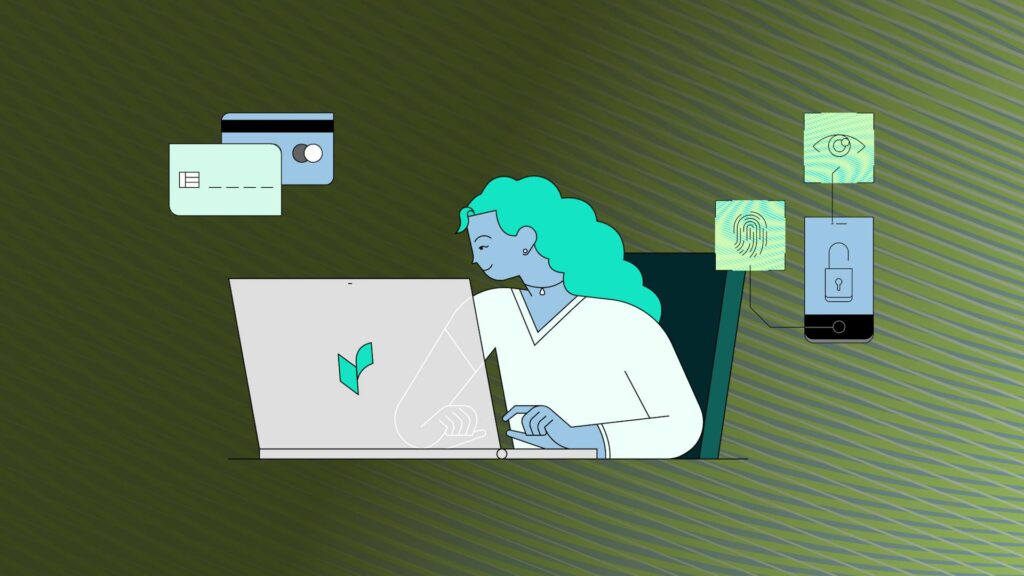
Digital identity can also include authentication credentials, such as usernames and passwords, PINs, one-time passcodes (OTPs), security tokens and passkeys. These help users prove they have access to an account or an authorised device and are often combined through multi-factor authentication (MFA) for added security. Behavioral biometrics, including typing rhythms, mouse movements, touch patterns and typical device interactions, provide additional signals that can help distinguish a legitimate user from someone attempting to impersonate them.
Finally, device and network signals provide context about how and where a person accesses a service. These may include device fingerprints, operating system and browser details, IP addresses, location and network type, such as a VPN, proxy or mobile carrier. By analysing these signals, organisations can identify familiar devices and flag potential risks, such as emulator use, unusual location mismatches or multiple accounts associated with the same device.
Importantly, a digital identity is not the same as a user account. A digital identity comprises the electronic data and attributes associated with a person and used to recognise or verify them online, while a user is the individual interacting with a digital service. One person can have multiple accounts and associated digital identities, such as a personal email account, an online banking profile and a work account managed by their employer. Each may contain different attributes and credentials, depending on the service and its requirements.

Your digital identity goes beyond your ID document. It combines personal data, credentials, biometrics, and digital signals to establish who you are online. For businesses, verifying that a real person is behind every interaction is essential to building digital trust.
The role of digital identity in business
Businesses rely on digital identity to authenticate users, prevent fraud, and streamline operations. In industries like financial services, eCommerce, healthcare, and government services, digital identity verification helps secure sensitive information and maintain compliance with regulations such as KYC (Know Your Customer), AML (Anti-Money Laundering), and GDPR (General Data Protection Regulation).
As cyber threats and identity fraud continue to rise, digital identity also plays a critical role in building trust across online interactions. With businesses shifting toward online-first operations, decentralized identity frameworks are emerging as a way to reduce reliance on centralized databases while improving security and privacy. The scale of the challenge is significant: Veriff’s Identity Fraud Report 2027 found that 3.7% of verification attempts in 2026 were flagged as fraudulent, a rate that has held broadly stable since late 2025.
How digital identity verification works
Digital ID methods let people prove who they are without scanning a physical identity document. Instead, they rely on identity data or credentials that a trusted source has already verified. There are three main types:
eIDs (electronic identity schemes)
With an eID, the user confirms their identity through a trusted third-party app, usually issued by a government or a bank. Examples include MitID in Denmark and iDIN in the Netherlands. The user leaves the verification flow, logs in to the eID app, agrees to share their data, and returns to the original flow with their identity verified. eIDs are particularly popular in countries where digital identity schemes are widely adopted.
Digital identity wallets
A digital identity wallet securely stores digital credentials on the user’s device, such as mobile driving licences (mDLs) in Apple Wallet or Google Wallet. Users can share credentials or specific identity attributes to meet different service requirements, often selectively disclosing only the information needed for a particular use case.
In the EU, European Digital Identity (EUDI) Wallets, introduced under the revised eIDAS framework (eIDAS 2), are intended to provide a recognised way for people to identify themselves and share verified identity data across a range of services.
Selfie-based verification against biometric registries
In some countries, users can verify their identity by taking a selfie and providing a few identifying details, such as a national ID number and date of birth. The selfie is matched against a portrait held in an official biometric registry, eliminating the need to scan a physical document. Examples include Brazil’s CPF-related biometric verification infrastructure and Nigeria’s National Identification Number (NIN) system. For example, Brazil Selfie IDV uses Brazil’s CPF biometric registry to verify identities.
Combining digital ID methods with physical document verification
While digital ID methods can make identity verification faster and more convenient, their adoption varies significantly across markets, and not every user has access to or uses the same digital identity solutions. Different methods also offer different levels of assurance and data. Some do not include a biometric component, while others may return fewer identity attributes than a business needs for a specific use case. This means that a digital method alone may not always meet the verification requirements.
Giving end users a choice is therefore essential. By combining digital ID methods with physical document verification in a single flow, organisations can offer users the flexibility to choose the method that works best for them while ensuring that the verification process meets the needs of the business and the required level of assurance.
This is the principle behind Veriff’s vision for Omni-method IDV: bringing digital identity methods and physical document-based verification together in one seamless flow. This approach accommodates different user preferences, varying levels of digital ID adoption across markets, and the specific assurance and identity data requirements of different use cases.

Want to dive deeper?
Discover how Veriff’s identity verification solution helps you onboard legitimate customers securely, detect fraud, and deliver a seamless user experience.
The future of digital identity
As digital interactions continue to evolve, the future of online identity is shifting towards greater security, flexibility, and user control. The rise of self-sovereign identity (SSI) and decentralized verification is giving individuals full control over their digital credentials, reducing reliance on centralized entities vulnerable to breaches.
Technologies such as blockchain-based digital identities ensure verifiable, tamper-proof credentials, while AI and machine learning make identity verification more seamless and adaptive. With regulatory frameworks like eIDAS 2.0 and NIST Digital Identity Guidelines advancing, businesses and individuals must prioritize digital identity solutions that balance security with user privacy. The EU’s revised regulation, Regulation (EU) 2024/1183, requires every Member State to provide citizens with an EU Digital Identity Wallet by the end of 2026. NIST published Revision 4 of its Digital Identity Guidelines (SP 800-63-4) in July 2025, the first major revision since 2017. Around the world, governments and businesses are paying closer attention to online safety, from regulating social media use to tightening KYC requirements and fighting AI-driven fraud, all making digital identities more relevant and adopted than ever.
As digital services evolve, digital identity will play an increasingly important role in how people access services and prove who they are online. Veriff’s Omni approach combines multiple signals across the verification journey to help businesses establish trust, detect fraud, and deliver secure, seamless digital experiences.
How Veriff can help
Veriff supports digital transformation with AI-powered identity verification that helps businesses meet regulatory requirements while delivering a more flexible user experience. By combining physical document verification, biometric authentication, digital identity verification, and real-time risk assessment, Veriff helps organizations reduce fraud, build trust, and streamline onboarding across borders.
With Veriff’s Omni-Method IDV approach, businesses can verify both user digital identities and physical identity documents in a single flow through a single integration. This gives organizations the flexibility to support different user preferences, regional requirements, and emerging identity ecosystems without adding complexity to their verification stack. Instead of relying on fragmented verification journeys, businesses can offer a unified experience that improves conversion while maintaining strong security and compliance standards.
Veriff’s solutions support KYC and AML requirements and are built with GDPR-compliant data handling, helping businesses keep up with changing regulations without adding friction for their customers. Across sectors like financial services, eCommerce, mobility, healthcare, and beyond, Veriff enables trustworthy, user-centric digital identity experiences that protect both businesses and individuals.
Conclusion: Strengthening digital identity security
The digital identity landscape is rapidly evolving, driven by emerging technologies and regulatory requirements. Organizations must implement multi-layered identity verification solutions to prevent fraud, ensure compliance, and create trust in digital interactions. As digital twins and AI-driven verification gain traction, businesses and individuals must embrace secure, decentralized, and privacy-first digital identity systems to navigate the modern digital ecosystem confidently.