Login
 Help Center
 How to get verified
KYC Software: Key Features, Capabilities, and Use Cases

Know your customer (KYC) has become an increasingly important factor in an era of complex AI-assisted identity threats. Having high assurance that you are dealing with a human, not a bot, and knowing who that human is helps prevent a variety of identity security attacks.
However, KYC is not a one-size-fits-all deal. Any approach to identifying a user of an identity-reliant service must be appropriate to that service. This requires KYC software to adapt to each situation.
Different industries and variable use cases across and within those industries must utilize KYC software that can draw upon a rich set of capabilities, including layers of use case and regulation-appropriate capabilities. These include identity verification, biometrics and liveness, fraud and risk detection, global document and geographic coverage, CDD/EDD, beneficial ownership, customer risk rating, sanctions/PEP screening, and ongoing monitoring. All of these must be implemented with minimal impact on onboarding speed while reducing user friction. Automation has become an essential element in streamlining KYC software capabilities during onboarding.
KYC software that minimizes fraud risk is essential to any identity-led service. US identity fraud has reached a staggering $27.3 billion, according to a study by Javelin Strategy & Research. The Veriff Identity Fraud Report 2026 has identified impersonation fraud in over 85% of attacks. However, in today’s ever-changing technology landscape, KYC software must deliver both performance and compliance.
Let’s explore the capabilities that KYC software must have to ensure accurate verification for both consumer-facing enterprises and employee identity accounts.
Summary of key features of KYC software
| Desired Feature | Description |
|---|---|
| Identity and document verification |
|
| Biometrics and liveness |
|
| Fraud and risk detection |
|
| Verification accuracy |
|
| Global document and geographic coverage |
|
| Onboarding speed and user friction |
|
| API, webhook integration, and SDK |
|
| Configurable workflows and orchestration |
|
| Automation |
|
| Manual review and fallback processes |
|
| Auditability and compliance records |
|
| Scalability |
|

-

Verify IDs, documents, addresses, age, global fraud databases, and sanctions lists
-

Increase confidence with biometric technology, image processing, and age estimation
-

Protect against fraud and money-laundering risk with AI-powered real-time detection
Identity and document verification
Identity is at the heart of cyber-risk: The Veriff Identity Fraud Report 2026 found that 1 in 25 verification attempts is fraudulent. The report also points out that digitally presented media is 300% more likely to be AI-manipulated. Robust, accurate identity and document verification lays the foundation for KYC software.
Accuracy must be based on a broad coverage of ID document types to ensure inclusion across a wide demographic. ID document support must include passports, driver’s licenses, national ID cards, and national health insurance cards. Many of these identity documents will be country-dependent.
KYC software capabilities must be configurable to cover specific use cases and user bases. For example, customer verification pathways may require different types of user verification journeys with varying identity checks. Also, regulation-specific requirements, such as KYC/CDD/AML legislation, will dictate the type of identity checks required. KYC software must adapt to these scenarios and requirements, supporting a broad range of ID documents through Identity Document Validation Technology (IDVT).
The graphic below shows how these identity and document verification steps typically work together in a KYC workflow.
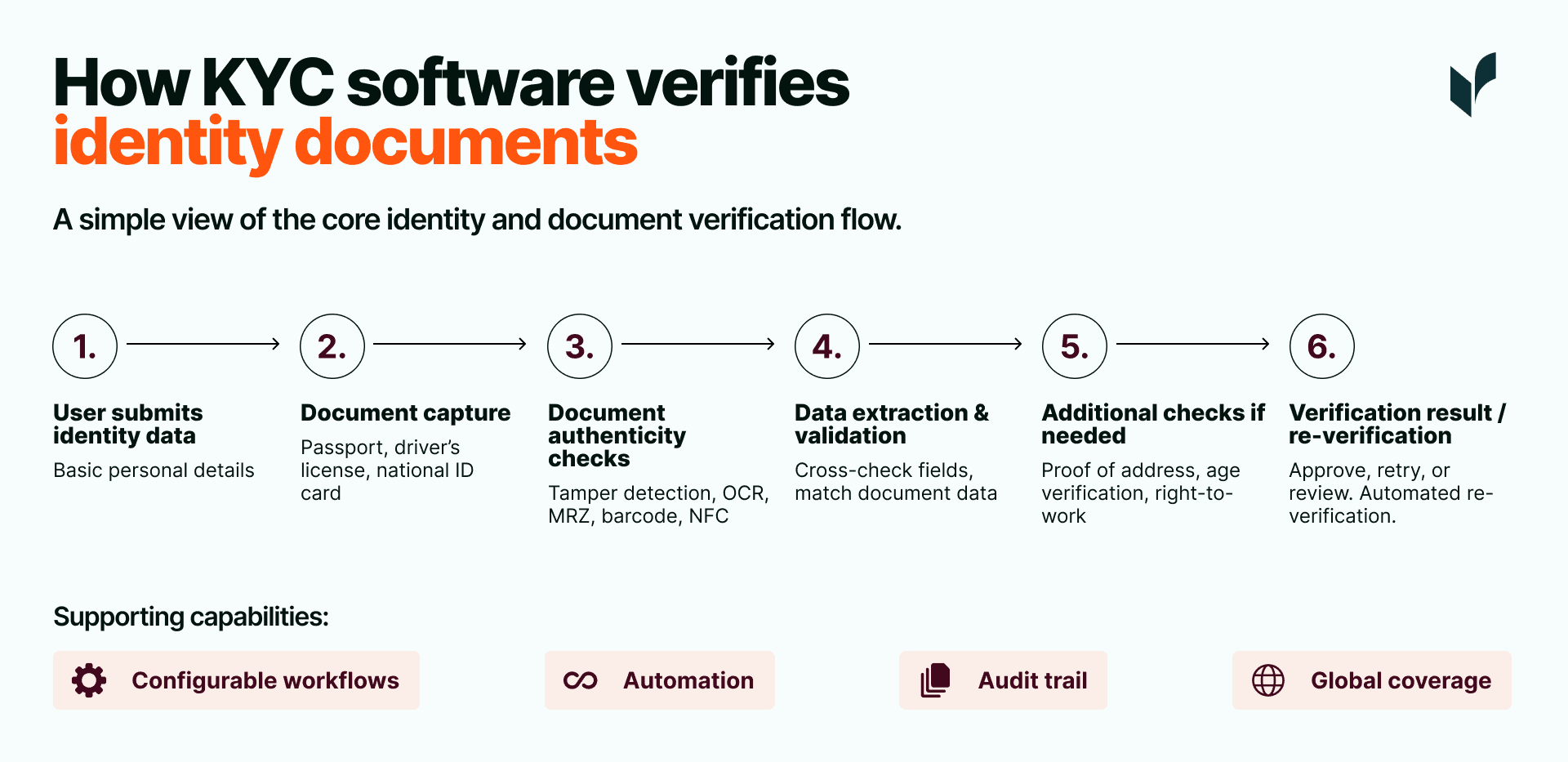
Core steps in the identity and document verification process
Use case examples that require specific ID verification include right-to-work and age validation. A case in point is that of Joyride, a leading software platform for micromobility operators. Joyride uses Veriff to capture the specific identity requirements needed to identify riders, including license category, age eligibility, and license length. Rider verification is automated, streamlining the process and providing a friction-reduced user experience.
Other supported screening methods required by KYC software to cover the myriad use cases and user types must include:
- Proof of address using extracted and validated data from bank statements, utility bills, and tax documents
- Reverification with biometric checks that can be automated and rules-driven
- Support for additional ID verification capabilities, including adverse media and PEP checks, with ongoing screening supported where required
Biometrics and liveness
Deepfake fraud cost businesses a reported $1.5 billion in annual losses in the first nine months of 2025. This insidious technique for thwarting identity verification solutions is a complex threat that requires specialized KYC software to deal with it.
Facial recognition is an essential capability of deepfake-resistant KYC software. The facial recognition technology must include the following capabilities to ensure robust, accurate, and rapid deepfake detection:
- Liveness as part of verification, which indicates life and includes real-time presence detection. It identifies synthetic or manipulated images and, importantly, this technique detects AI-generated deepfakes.
- Passive liveness helps prevent user fatigue and improves the user experience. Unlike active liveness, passive liveness does not require the user to perform actions like blinking or turning their head.
- Deepfake-resistant KYC must defend against streamed or pre-recorded videos that could be deepfakes in nature.
- KYC software should handle low light and motion blur.
- Facial recognition technology should conform to ISO/IEC 30107-3 for presentation attack detection.
The image below shows how several liveness signals can be combined during verification.
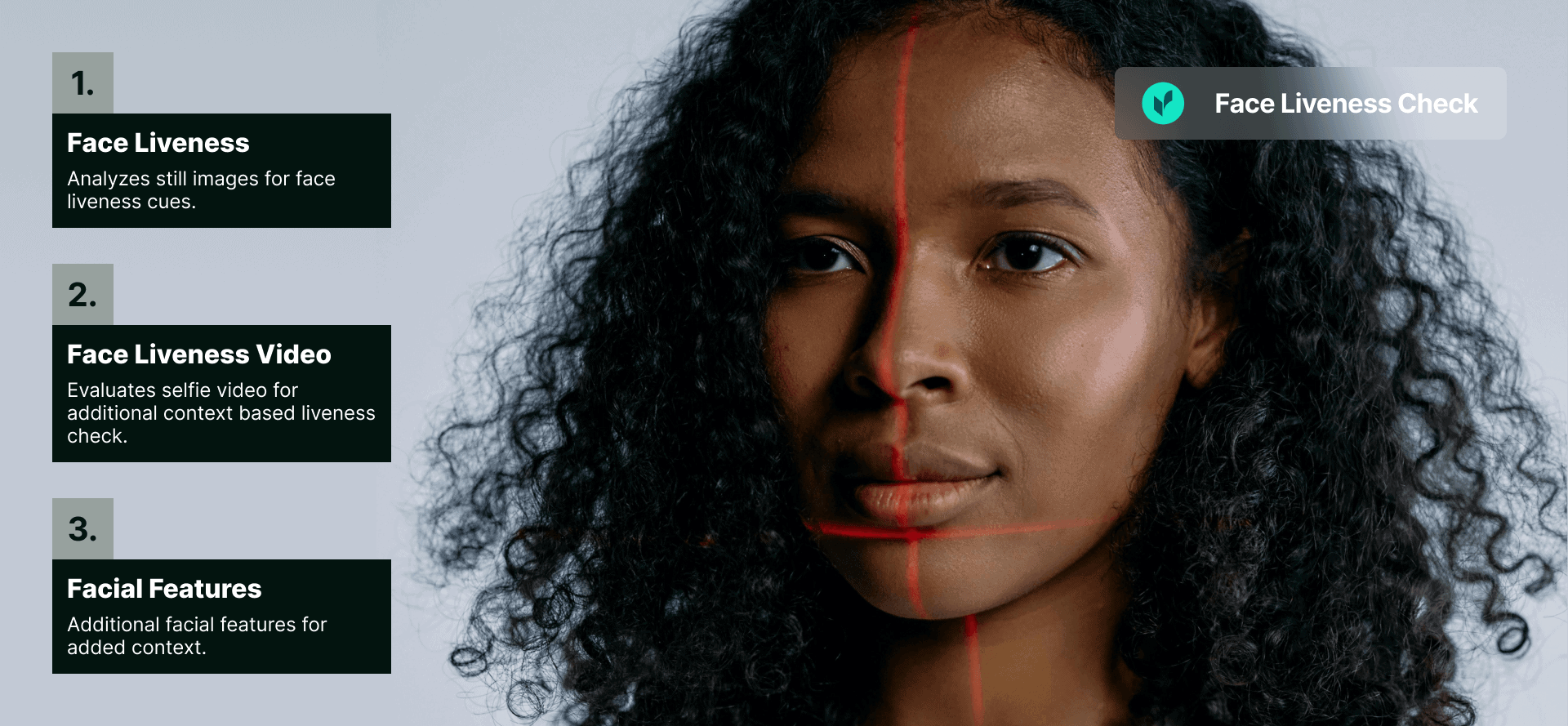
Signals used in Veriff’s liveness analysis
Fraud and risk detection
Modern fraud tactics often use multi-part, distributed attack chains that make detection challenging. AI-assisted fraud makes attacks faster and more believable, using AI to perfect manipulated images. AI-powered, scalable fraud detection and prevention using KYC software can help fight fraud. AI-driven fraud detection uses layers of verification to catch complex fraud attempts.
Sophisticated AI-driven KYC solutions, such as Veriff, identify complex and persistent fraud using technology like Veriff’s CrossLinks. This technique cross-references documents, devices, networks, and behavioral indicators to capture complex chains of attack. Providing this capability at the per-transaction level enables fraud teams to consolidate data and make informed decisions.
Furthermore, support for fraud teams to refine rules and develop strategies for emerging threats ensures that the KYC software is future-proofed against an ever-changing threat landscape. A case in point is Kueski, a leading AI-powered buy now, pay later (BNPL) platform that deeply integrates Veriff’s AI-powered fraud controls to respond dynamically to new fraud patterns.
Verification accuracy
Fraud mitigation relies on verification accuracy. However, ensuring an accurate match is challenging, especially in an era when deepfakes are used to trick verification services. Accurate verification is achievable with a system that relies on multiple data points, cross-referenced against both known and emerging fraud.
Facial biometric technologies can reduce accuracy because of poor image capture conditions. This can also lead to usability issues and user fatigue. Biometric capture may take place in low light or with motion blur; hand shaking, for example, causes image capture to fail, resulting in user fatigue and annoyance. User journeys are interrupted, and onboarding verification accuracy diminishes or fails altogether.
Accurate facial biometrics must handle these conditions. Veriff’s Assisted Image Capture guides users on how to take an optimal selfie, ensuring accuracy and reducing user fatigue.
Against a benchmark of 30,000 documents, Veriff can achieve 100% detection of synthetic documents by continuously monitoring, ingesting, and learning from online fraud attempts. Effective KYC software relies on data from multiple verification signals, including IDV and biometric liveness, to ensure accuracy and low false-positive rates.
Global document and geographic coverage
We live in a connected world, and many businesses have employees, contractors, customers, and clients that span multiple global locations. Take the online language learning community Preply: The organization has over 150,000 tutors from 180 countries, teaching 90 languages and over 120 subjects. It needs robust and effective KYC software that reaches this broad geographic audience.
Preply uses verification software to securely identify tutors. Verification requires worldwide coverage of ID documents from hundreds of countries, each with its own approach to identifying citizens. Broad coverage of identity documents also must include support for multiple languages and dialects. Preply chose Veriff for its identity verification needs because of its broad ID document coverage and multi-language support.
Worldwide ID document support also means complying with jurisdictional differences. KYC software should support jurisdiction-specific laws and regulations, such as GDPR, CCPA/CPRA, and AML directives. Ideally, KYC software should meet the requirements of certifications like ISO/IEC 27001 and SOC 2 Type II.
Onboarding speed and user friction
Robust, accurate, and secure identity verification for KYC must strike a balance between performance and reduced user friction. Identity checks must be analyzed quickly; decisions should be made in seconds, not minutes. Auto-document detection helps improve speed without impacting accuracy. Scalability must not compromise usability. KYC software should offer a guided user experience that collects real-time feedback to improve pass rates and reduce customer drop-offs.
Biometric authentication supports passwordless login, improving the user experience. Passive liveness ensures a seamless, robust, and smooth verification process.
Bolt, a leading short-term car rental mobility app, uses Veriff to automate and enhance its customer onboarding experience. Bolt faced unique challenges, requiring a seamless and fast user experience with zero tolerance for fraud; high verification accuracy was critical. Bolt uses Veriff to automate user onboarding to ensure a seamless, rapid, and accurate verification process.
API, webhook, and SDK integration
An API allows two software systems to exchange data and functionality directly. A webhook automatically sends an update to another system when a specific event occurs, such as a verification result becoming available. An SDK is a set of development tools that helps businesses integrate identity verification features directly into an app or website. API and webhook support are integral to fast and accurate decision-making. However, accuracy relies on deepfake detection and real-time analysis of incoming sources: Assume no capture-side signal indicates whether a breached document has entered the flow. KYC software architecture should be modular, with an API that enables rapid, seamless integration into your product, while also incorporating deepfake detection mechanisms to ensure high-assurance insights.
An API is potentially more exposed to deepfake attacks. Images arrive as uploads, so any API-submitted media should be treated as a potential injection. The added complexity is that a genuinely leaked document will legitimately pass authenticity checks; the defense then rests almost entirely on downstream face liveness and synthetic-media detection. When capturing media such as facial biometrics and documents, a controlled capture flow can distinguish genuine live capture from injected images by relying on liveness and injection detection at the point of capture.
Granular webhook options enable multi-system communication and streamline workflows. Direct integration into your product ensures fast, accurate verification decisions and a seamless user journey. KYC software that provides real-time verification data ensures rapid decision-making. Importantly, webhook coverage must handle responses from capabilities that include global ID document coverage, watchlist screening, and verification flow progress events to support real-time decision-making.
KYC software with an SDK enables fast integration and fraud prevention. A KYC SDK gathers and orchestrates data from various sources to improve fraud detection. SDKs must offer cross-platform support, including iOS, Android, and web SDKs.
Configurable workflows
Workflows are rarely one-size-fits-all; they typically reflect many situations, users, and use cases. Configurable workflows must be easy to set up, with no custom engineering. For example, your user base may span a wide range of customer types across a broad geographic area. A configurable workflow lets you set up variable user journeys that guide users down alternative pathways based on their specific verification requirements, including identity documents and other jurisdictional and demographic considerations. A tried-and-trusted way to configure workflows is to chain multiple checks into a single automated flow.
Another essential aspect of configurable workflows is that of continuous improvement as environments and user habits change over time. Continuous feedback trains the workflow to optimize user match rates. Configurable workflows matter as they ensure a more flexible approach to verifying users across broad demographics. The result is a reduction in user drop-offs, more efficient user journey pathways, and a more accurate reflection of verification requirements
Drop-in capture flows for iOS, Android, and web are an important capability to consider when evaluating KYC software with configurable workflows. This powerful no-code feature means that you don’t need to build your own UI.
Automation
Automated workflows make a big difference to identity verification by streamlining diverse workflows, speeding up the user journey, and reducing friction. As such, AI-powered automation takes efficiency to new heights, balancing accuracy, usability, and security. Automated workflows reduce customer drop-offs by streamlining onboarding.
AI-assisted automation supports automated checks, document recognition, data extraction, and reduced manual input. Response times and decision-making improve during identity verification. Automatic document type recognition and data extraction help to minimize manual user input and reduce user error.
Automated workflows can be connected via an API or webhooks to existing tech stacks, with little to no developer input. Apps like Zapier can connect Veriff identity verification to popular apps such as Dropbox, Slack, and HubSpot: onboarding becomes seamless, fraud detection improves, and customer drop-offs decrease.
The graphic below shows how configurable KYC workflows can combine automated checks with manual review when a case cannot be resolved automatically.
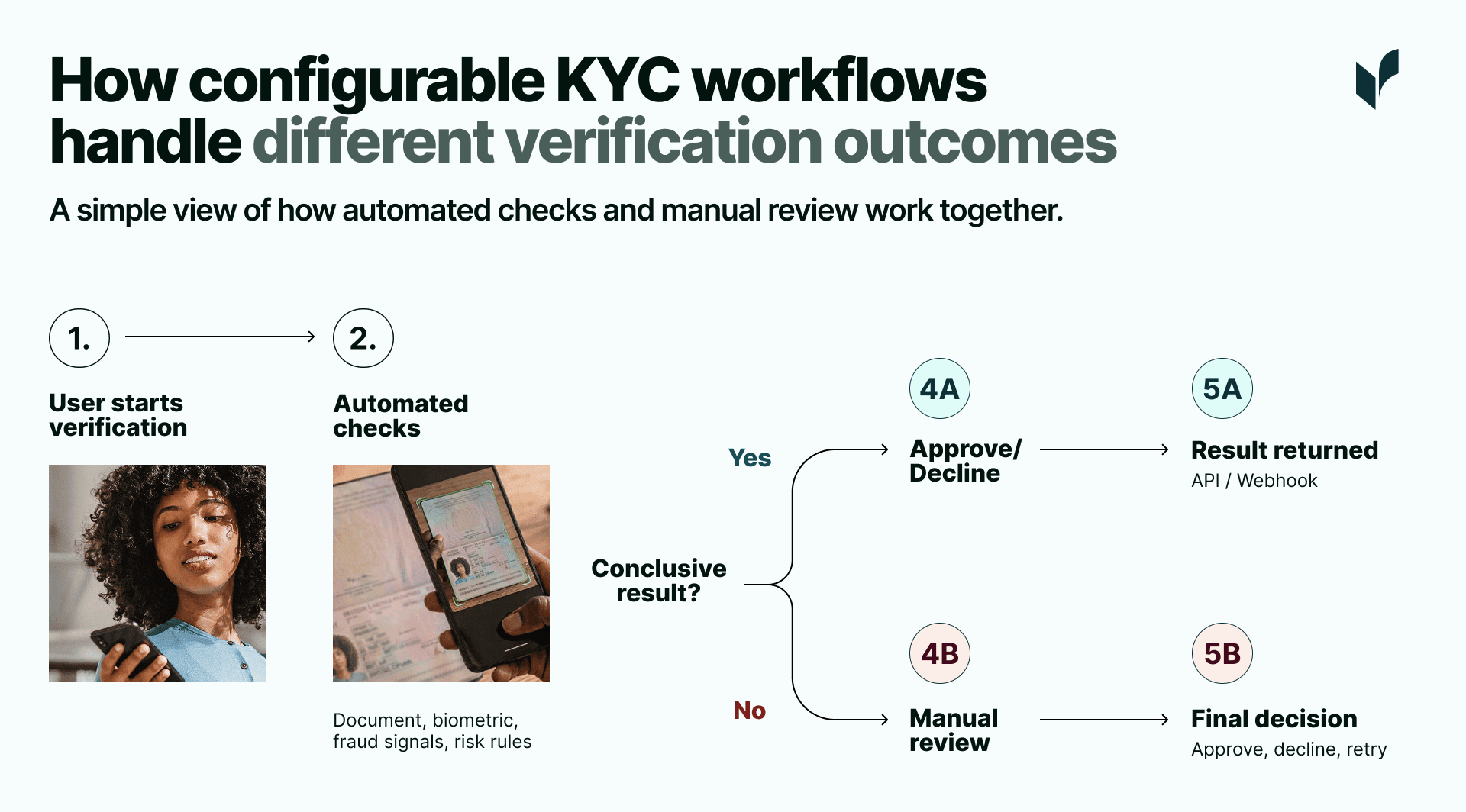
How configurable KYC workflows handle automated and manual verification outcomes
Manual review and fallback processes
A hybrid verification model that complements automation with manual intervention, if needed, is a useful capability to explore when evaluating KYC software. During a manual process, a human reviewer typically confirms identity documents, boarding status, watchlist resolution, and other specific verification conditions.
For example, some edge cases may result in an inconclusive AI decision because of poor lighting or high-risk signals. In these cases, the system routes the session to an in-house manual fallback specialist. This human review layer steps in to verify details manually, maintaining high accuracy and preventing false rejections.
A manual fallback process helps preserve throughput across the user journey if and when needed. Manual processes, however, must meet the same assurance level as the automated counterpart. That’s where verification specialists come in. Trained specialists who can identify and handle unusual ID documents and conditions verify the individual and allow the user journey to be completed at a high assurance level. Not all KYC software has this built-in flexibility, but you should consider it when selecting a KYC software provider.
Auditability and compliance records
Comprehensive audit records that capture events across a user identity verification journey are essential for compliance. These audit records include details of the verification process, the ID documents and biometrics used, and the results of verification checks and AI responses.
KYC software must be designed to capture logs of each event to provide a complete, auditable record of the customer identification process from initial interaction through to the final decision. Audit trails must provide time-stamped evidence of KYC checks and collect consent logs. Additionally, the KYC solution itself must be audited to ensure regulatory compliance by industry/jurisdiction.
Scalability
Scalable KYC software is imperative as businesses grow and bring on new employees, contractors, clients, and customers. Scalable KYC software must also adapt to diverse business needs across connected business units, often across multiple countries. Scalable KYC architecture must be designed to handle high verification volumes with robust, reliable performance.
Scalable, high-performance KYC was an essential ingredient when one of the world’s largest on-demand food delivery platforms chose Veriff for customer and client verification. The food delivery platform works across 45 countries, connecting millions of consumers with independent couriers and local restaurants. Verification includes age verification, right-to-work checks, and KYC. Veriff provided all verification checks in a scalable, robust, and efficient way, maintaining seamless onboarding.
Conclusion
Identity verification is essential to maintaining a safe and secure environment for employees, customers, clients, and other users of a service or app. However, identity verification is at a juncture, with AI-assisted deepfakes challenging the accuracy and effectiveness of KYC software.
KYC solutions must work in complex environments. They are the interface between humans and digital technology. Beyond multiple layers of verification technology and support for myriad ID document types, they must also be built for scalability, accuracy, and flexibility. On the front line of fraud detection, KYC software must provide layers of capabilities to meet this challenge. AI-powered identity verification is a strong response to AI-assisted fraud.
KYC solutions that combine automation with accurate identity verification and assisted biometric liveness help streamline the user journey. Together, they balance the security needed to thwart identity-focused attacks with a usable service that prevents customer drop-offs. This rich set of requirements makes KYC software one of the most complex solutions to evaluate. The list of KYC software capabilities in this article should help you establish a baseline of features that will ensure you can deploy the optimal solution for your business. Explore Veriff’s identity verification solutions to see how these capabilities can support your KYC workflows.
Subscribe for insights