Login
 Help Center
 How to get verified
ON THIS PAGE
November 26, 2026


IDV Article
The EUDI Wallet and eIDAS 2.0: What relying parties need to know for 2027
Are you ready for the EUDI Wallet?” If you work in onboarding, compliance or fraud, someone has probably asked you this already. With AMLR coming in July 2027 and eIDAS 2.0 wallet acceptance following in December, the planning window is closing. Here’s what the wallet is, who has to accept it, and why document-based IDV still matters
Why this matters now
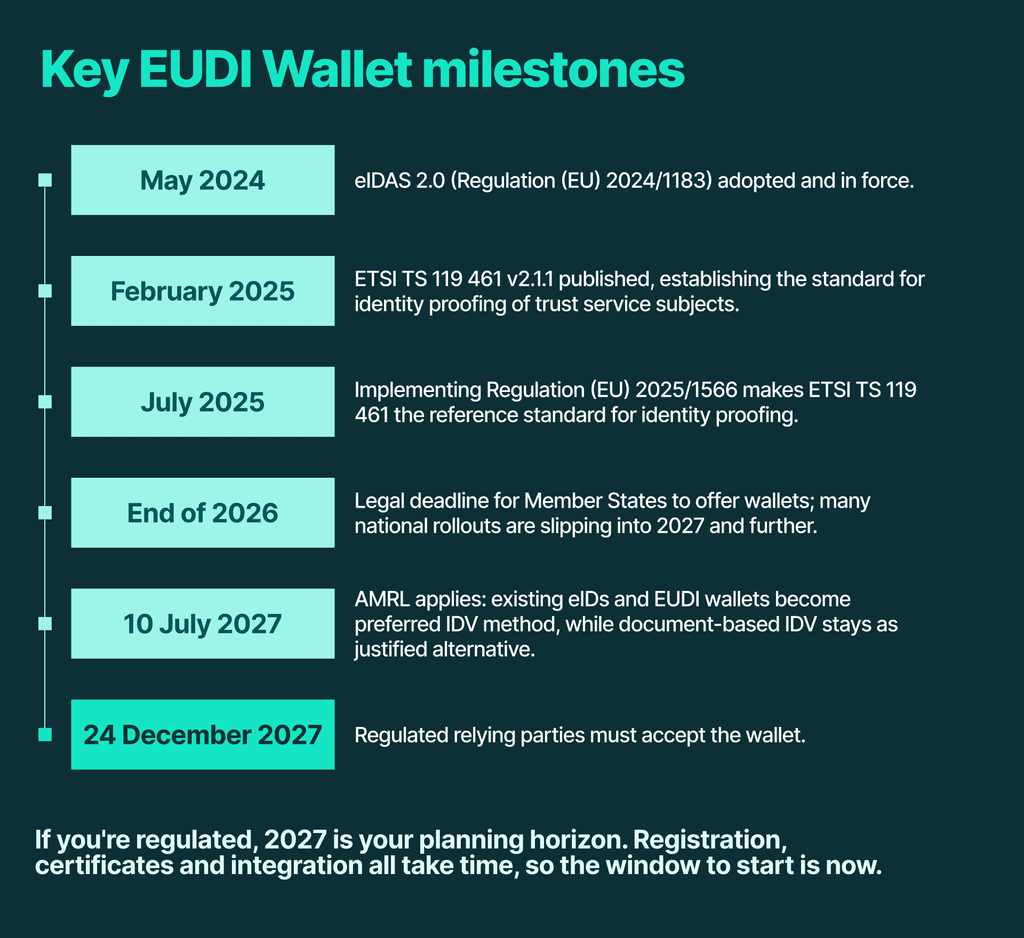
In 2027, two major EU regulations, the Anti-Money Laundering Regulation (AMLR) and eIDAS 2.0, will introduce significant changes for businesses. AMLR, a single EU rulebook for customer due diligence, applies from 10 July 2027 (Regulation (EU) 2024/1624, Article 90). Under eIDAS 2.0, regulated businesses and public sector organisations required to use strong user authentication must accept the European Digital Identity (EUDI) Wallet starting from 24 December 2027 (Regulation (EU) 2024/1183, Article 5f).
Soon your customers will be able to prove who they are with an app on their phone. If you run onboarding, compliance or fraud, this question is probably already on your desk. Many businesses are putting the same question to their identity verification (IDV) providers: are you ready?
This guide covers what the wallet is, who has to accept it and when, what you need to do, and why document-based IDV stays part of the picture. The short version: EUDI wallets will be used together with document-based IDV and existing eIDs, so plan wallet-first, not wallet-only.
What is the EUDI Wallet?
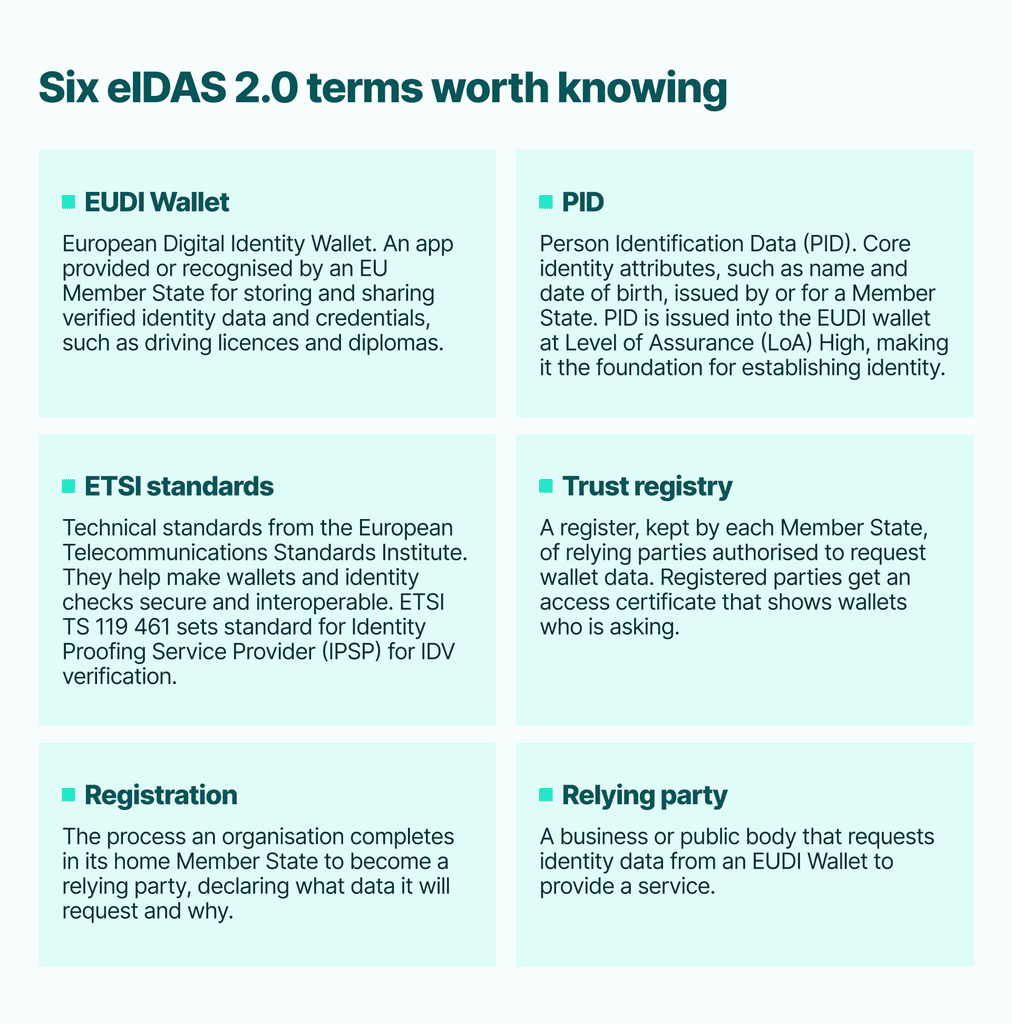
The EUDI Wallet is a smartphone app that each EU Member State issues or endorses. It can store a wide range of verified personal data attributes, including a driving licence, a diploma, and many more. From an identity verification (IDV) perspective, the most relevant attribute is Person Identification Data (PID), which contains verified information about the user’s identity.
Its defining feature is selective disclosure: the user shares only what a service requests. An age-restricted platform can ask “Is this person over 18?” and get a yes or no, without ever seeing a full date of birth.
For the user, that means more control. For you, it means less data to collect, store and protect.
If you’re regulated, 2027 is your planning horizon. Registration, certificates and integration all take time, so the window to start is now.
What relying parties need to do
Under Article 5f of the eIDAS Regulation, you’ll need to accept EUDI Wallets if a law or contract requires you to use strong user authentication to identify customers online. This applies in sectors such as banking and financial services, telecoms, health, transport, energy and education, though micro and small enterprises are exempt. Very large online platforms under the Digital Services Act (DSA) must also accept the wallet whenever they ask users to authenticate
Being a relying party comes with a few concrete obligations:
1. Register as a relying party with the designated authority in the Member State where your organisation is established.
2. Obtain a registration certificate. Once registered, you’ll receive a certificate confirming your status as a relying party. This is a mandatory step for organisations seeking access to the EU Digital Identity Wallet.
3. Obtain a wallet-relying-party access certificate. This certificate allows you to request data from the wallet and proves to the wallet who is making the request.
4. Request only the data you’re authorised to access. Your access certificate defines which attributes you can request. If you ask for data beyond your authorised scope, the wallet will refuse the request.
Many businesses will connect to wallets through an IDV provider. That’s a sensible route, but it doesn’t change who the relying party is. If your provider acts on your behalf, you are still the relying party. Registration, certificates and the purpose of the request stay tied to your business, so plan that work alongside the technical integration.
How the wallet fits into your existing IDV flow
For the user, wallet verification should feel like any other onboarding step. A typical journey looks like this:
1. The user chooses “Verify with EUDI Wallet” from the available methods.
2. They’re redirected to their wallet app.
3. They authenticate in the wallet (PIN or biometrics) and approve what’s shared.
4. The result comes back to you like a normal verification decision.
The flow can start in two ways. Same-device (app-to-app) works when the user is already on their phone. Cross-device uses a QR code, so a user on a laptop can scan it and finish on their phone.
The strongest setup isn’t a separate wallet journey. It’s one flow that offers the wallet, national eIDs and a physical document with a selfie, so each user can pick the best option they have. Someone with a wallet finishes in a few taps. Someone without one still gets through.
Whichever path a user takes, you need to know which method they used. That matters for regulatory reporting, for audit trails and for understanding conversion by method.
Key milestones on the road to EUDI Wallet adoption
The transition to EUDI Wallets is happening in stages, with several regulatory and technical milestones shaping the timeline. From the introduction of eIDAS 2.0 to the July 2027 AMLR application and the December 2027 acceptance deadline, businesses need to understand not only what is changing but also when. These milestones provide a practical timeline for planning registration, certificates and technical integration ahead of the regulatory deadlines.
This way, the infographic adds context without interrupting the narrative about the user verification journey.
Scope gaps to plan for
While businesses may be required to accept EUDI Wallets, this does not mean that every user will have one or choose to use it for identity verification, particularly given the uneven rollout and still-uncertain adoption rates across the population. The wallet is also a European credential, meaning customers from outside the EU and EEA will not have access to one. Additionally, the wallet may not provide all the information a business needs to meet its identity verification and AML due diligence requirements. For example, it may not return a face image, residential address or national ID, depending on the credentials shared. Finally, verifying the wallet does not necessarily mean verifying the person presenting it. While the EUDI Wallet can confirm that a user holds verified identity credentials, it does not automatically establish that they are the legitimate owner. Additional measures, such as liveness checks and face matching between a selfie and the portrait returned by the wallet, can help confirm the user’s identity and prevent impersonation fraud.
Adoption will be gradual
Although businesses may be legally required to accept the EUDI Wallet, that doesn’t mean every citizen will have one or be ready to use it. Adoption will take time and is likely to vary significantly across countries, as the existing eID landscape already shows. According to Eurostat, 52% of EU citizens used an electronic ID to access online services in 2025, but adoption ranged from 99% in Denmark to just 15% in Germany and 10% in Romania. Usage is even lower when it comes to commercial services, with only 25% using eID to access services from businesses. Awareness of the new wallets is another challenge: an August 2026 survey in Austria found that 62% of respondents had never heard of the EUDI Wallet. Rollout timelines also differ, with some countries, such as the Netherlands, not expecting a public launch until 2028. For businesses, this means the wallet will become an important verification option, but it cannot be the only one.
The fraud question
The EUDI Wallet is designed to provide a high level of assurance, with strong protections for the credentials it contains. However, wallet-based verification typically does not include a selfie check on the business’s side, raising important questions for fraud and risk teams. What happens if someone takes control of another person’s device or wallet credentials? A legitimate wallet holder could also be pressured or tricked into approving a credential share, or someone could use their unlocked phone without their consent. Meanwhile, malware, SIM swaps and social engineering attacks target the device itself rather than the credential, and money mules can use their own genuine identities and wallets to open accounts on behalf of others. In other words, the wallet protects the credential, but it doesn’t necessarily confirm the intent of the person using it. That’s why additional risk signals, such as device and network fingerprinting, crosslinking and ongoing monitoring, remain important both before and after onboarding.
Fallbacks are part of the design
Every wallet flow needs a fallback. Document verification with liveness is the natural choice, used when:
• the user doesn’t have a wallet yet,
• the user starts the wallet step but abandons it,
• the wallet service is unavailable, or
• the wallet can’t provide an attribute you need.
Decide early who owns that fallback. You can build and route it yourself, or let your IDV provider handle it inside one flow. Either way, the user shouldn’t hit a dead end, and your team shouldn’t be stitching results together by hand.
Contact Us
Talk to our team about building one flow for wallets, eIDs and documents.
Where Veriff fits
Veriff is building toward one flow that connects businesses to the verification methods their users have: EUDI Wallets, national eIDs and document-based IDV. The goal is simple: one integration and one result format, whichever method a user chooses, with the method recorded for audit.
Where a wallet isn’t available or doesn’t cover what you need, the flow falls back to document verification across 12,500+ document specimens from 230+ countries and territories, with fraud signals applied throughout.
On standards, Veriff is actively pursuing certification of its physical-document identity verification product as an Identity Proofing Service Provider (IPSP) against ETSI TS 119 461 (v2.1.1) at the High / Extended Level of Identity Proofing, the identity-proofing standard aligned with eIDAS 2.0. Third-party laboratory evaluation and engagement with an accredited Conformity Assessment Body are both in progress.
Five things to do in 2027 planning
1. Confirm whether you’re a relying party, and in which Member State you’ll register.
2. Map your attributes. List the data each use case needs, and check which of it the wallet will and won’t provide.
3. Start registration and certificates early. Access and registration certificates belong to your business, even if a provider integrates for you.
4. Design one flow with fallbacks. Offer the wallet, eIDs and document verification side by side, and record which method each user took.
5. Keep fraud controls in place. Treat the wallet as a strong credential, not a complete risk decision.
The EUDI Wallet is a real step forward for privacy and user experience. The businesses that benefit most will treat it as one strong option inside a flexible flow, not a switch they flip in December 2027.
Getting ready for the EUDI Wallet? Talk to our team about building one flow for wallets, eIDs and documents.