Login
 Help Center
 How to get verified
ON THIS PAGE
- How would you describe Presence Verification to someone non-technical?
- What problem does Presence Verification solve?
- What's changed that makes liveness alone not enough?
- What question does a liveness check answer, and what does it leave unanswered?
- Can you share an anonymized example of a coached session that passes liveness?
- Which signals matter most when you say Presence Verification “looks at the whole session”?
- How does it catch emulators and virtual cameras, and why stop them before the one-time passcode (OTP) or payout step?
- How does coercion detection work, in simple terms?
- What this means for your verification flow
October 29, 2026


IDV Article
Liveness alone is no longer enough. Here’s what closes the gap.
A real face on camera doesn’t guarantee a genuine session. Geo Jolly, who leads Veriff’s biometrics product team, explains what liveness checks leave unanswered and how Presence Verification looks at everything around the face.

For years, the central question in biometric verification was simple: is this a real person? Liveness detection answers that question well, and it remains an essential layer of any identity verification (IDV) flow.
But the attacks growing fastest today don’t try to fake a face. Some fake the camera, feeding synthetic video straight into the app. Others put a real, live person on screen while someone else quietly directs every move. In both cases, the face passes. The session doesn’t deserve to.
We sat down with Geo Jolly, Group Product Manager at Veriff, to talk about what has changed, where liveness stops, and how Veriff’s newly released Presence Verification helps businesses confirm that a real person is present, acting on their own, from a genuine device.
How would you describe Presence Verification to someone non-technical?
It confirms that a real person is present, that they’re completing the verification on their own without any third-party influence, and that nothing about the session has been faked. Most liveness checks stop at “is this a real face?” We go further and ask “is this person being told what to do?” and “is this session coming from a real device?”
What problem does Presence Verification solve?
We solve three things:
- Human realness. Vision and device physics determine whether you’re dealing with a genuine, live human, not a deepfake or a bot.
- Coercion detection. Full audio and video analysis determines whether the user is acting freely.
- Veriff Network. Insights from previous sessions determine whether the incoming user is a known fraudster.
What’s changed that makes liveness alone not enough?
Fraud moved. A year ago, the main attack was holding a photo or a mask in front of the camera. Liveness handles that.
Now the attacks growing fastest are different. One is injection: feeding a synthetic video directly into the app, so the camera never sees a real scene. The other is the coached session, where AI agents and bots, or humans, guide users through the process. Liveness can pass both of those, because there is a real face.

The fraud isn’t in the face. It’s in everything around it.
What question does a liveness check answer, and what does it leave unanswered?
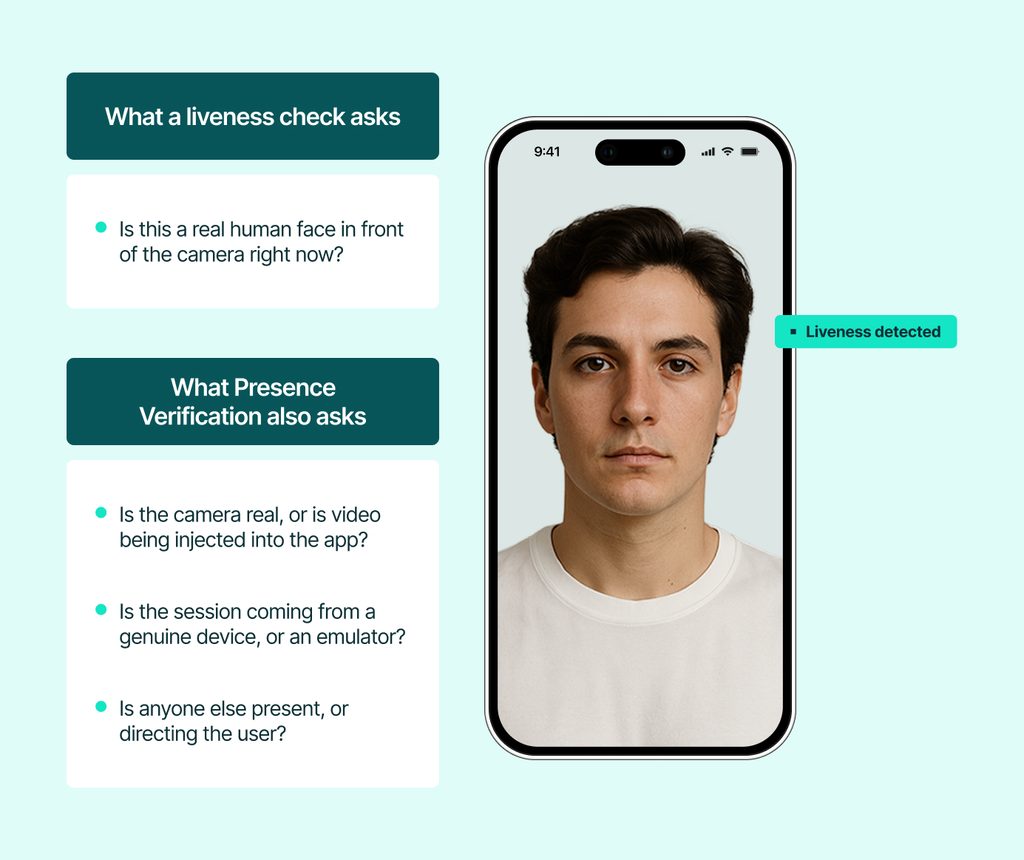
Liveness answers one question: is that a real human face in front of the camera right now?
It doesn’t answer whether the camera is real, whether the video is being injected, whether someone is standing behind the user telling them what to do, or whether the session is coming from a genu
Can you share an anonymized example of a coached session that passes liveness?
Take financial services. Someone wants a buy now, pay later (BNPL) loan, but they can’t pass verification on their own. Maybe the identity isn’t theirs. Maybe a fraudster is running the application. So the fraudster finds a real person and coaches them through it: “Hold your phone like this. Look at the camera. Now turn your head.”
The person on camera is real, alive, and looking at the camera. Liveness passes. But the session isn’t genuine, because someone else is controlling it. The person taking the selfie may not even know what they’re being used for. This hits lenders, BNPL providers, and anywhere a fast approval can turn into easy money for a fraudster. Take the gig economy. A rider needs to re-verify to keep working, but they can’t pass on their own. Maybe they bought or borrowed the account. So they call someone who walks them through it: “Hold your phone like this. Look at the camera. Now turn your head.”
Which signals matter most when you say Presence Verification “looks at the whole session”?
There are three layers.
By analyzing device and network signals, the video itself, and audio, organizations can build a more complete picture of what is happening during a verification session. They can assess whether the device is genuine or an emulator, detect signs of video injection, and check whether device sensors behave as expected. Video analysis can reveal whether multiple people are present or someone in the background is directing the session, while audio analysis can identify voices giving instructions. Together, these layers of intelligence can uncover signs of manipulation or coercion that a single-frame liveness check may miss.

Verify businesses with confidence
Is your user real? Why liveness is the new standard in fraud prevention
How does it catch emulators and virtual cameras, and why stop them before the one-time passcode (OTP) or payout step?
We look at device fingerprints, sensor data, and how the media arrives. A real phone produces camera data with specific sensor signatures. An emulator or virtual camera doesn’t: the data is either missing or inconsistent.
We catch this before the session progresses because once someone passes verification and gets an OTP or a payout, reversing it is expensive or impossible.
The cheapest fraud to stop is the fraud you stop before it completes.
How does coercion detection work, in simple terms?
We analyze the full session, both video and audio, for signs that someone else is telling the user what to do, such as giving instructions, dictating information, or directing their actions. Background noise or a TV playing doesn’t trigger it. It’s specifically looking for a second voice that’s guiding the session. Combine that with video analysis that checks whether another person is present or visible, and you get a picture of whether the user is acting independently or being coached.
What this means for your verification flow
Liveness still matters. It stops presentation attacks such as photos, screens, and masks. What has changed is where the risk sits. For platforms where an account, a payout, or access to work carries real value, the questions worth asking now go beyond the face:
Is the session genuine?
Device, network, and media signals show whether the camera feed and the device are what they claim to be.
Is the user acting on their own?
Video and audio signals show whether someone else is present or directing the session.
Is the check happening early enough?
Catching a faked or coached session before an OTP, payout, or account access is granted costs far less than unwinding it afterward.
For gig platforms, marketplaces, and any business running reverification, those answers decide whether the person you approve is the person doing the work. Presence Verification is built to help you answer them with confidence.