Login
 Help Center
 How to get verified
ON THIS PAGE
- There’s no passport for companies
- The registration number: your best friend, with conditions
- The number they know vs the number the registry wants
- The brand on the box vs the name on file
- Right country, wrong register
- Tax IDs: the number everyone actually remembers
- Can’t find the company? Six common reasons
- Where Veriff Business Verification fits
- The right number, in the right registry
November 11, 2026


Blog Post
How KYB search works: Matching business names, registration numbers, and jurisdictions
Registry lookups are rarely straightforward—search “Amazon” and you’ll find dozens of unrelated entities. The fix? Knowing the right name, registry, and business number.

Type “Amazon” into a business registry and see what happens. You won’t get a company called just “Amazon”. You’ll get a handful of entities with long legal names and, depending on the registry, a few businesses that simply liked the name of the river. Somewhere in that list is the company your customer actually runs. Probably.
Finding the company is supposed to be the easy part of Know Your Business (KYB). Look it up, confirm it exists, then get on with the real questions about who owns it and who runs it. When we started building a search for Veriff Business Verification, though, this “easy part” turned out to be where a lot of onboarding journeys quietly stall.
This post is about why. Every country has its own registries, its own numbers and its own ideas about what a company name looks like, and any of those quirks can hide the business you’re looking for.
In short, finding the company usually comes down to three things: the right register, the right number, and the legal name rather than the brand.
There’s no passport for companies
People are relatively easy. Most of us carry a passport or ID card, issued in a format the whole country uses. Companies get whatever their home registry decides to give them, in whatever format that registry likes, and no global register ties it all together.
That’s why the official business registry in each jurisdiction is the source of truth, in every part of the world. The catch is that there are hundreds of them. Each one decides what to store, which numbers to issue and how you’re allowed to search it. A search that works beautifully in one country can come back empty in the next, simply because the registry on the other side works differently.
The registration number: your best friend, with conditions
If your customer knows their registration number, celebrate. Names repeat and change, while a registration number is issued once and meant to point to exactly one company. It gives the cleanest matches by far.
It does come with conditions. A registration number is unique the way a house number is unique: extremely useful, as long as you also know the street.
Germany makes the point nicely. Register numbers are issued by local register courts, and each court counts on its own. So HRB 1234 Bamberg and HRB 1234 Bochum are two completely unrelated companies. Search for “HRB 1234” alone and you may get a whole list of them, with the city of the register court as the only thing telling them apart.
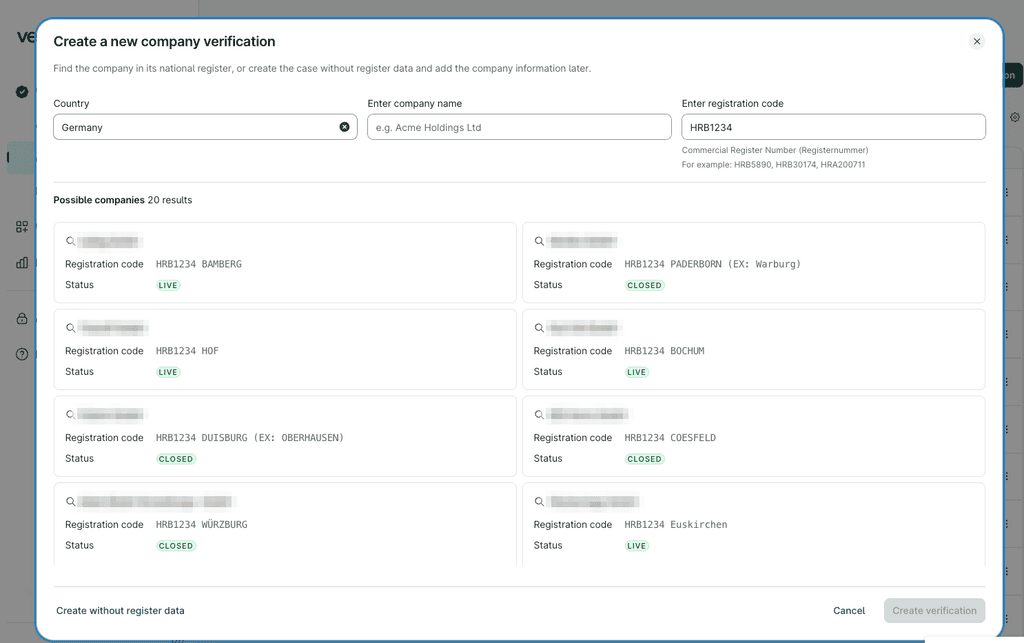
One registration number, many companies: searching HRB1234 in Germany in Veriff Business Verification. Company names blurred.
Then there’s formatting. A Swiss company identification number (UID) usually looks like CHE-123.456.789, but customers also type CHE123456789, plain 123456789, or the version from their invoices with a value-added tax (VAT) suffix attached, such as CHE-123.456.789 MWST. Whether a search recognises all of these depends on the registry and on any data provider in between. Some shrug off dots and dashes. Others insist on the official format, down to the last hyphen.
Verify businesses with confidence
Learn how business verification helps you reduce fraud, manage risk, and onboard legitimate businesses with confidence.
The number they know vs the number the registry wants
Often the number a customer knows by heart isn’t the one the registry is built around. An Italian business owner may quote their REA number (Repertorio Economico Amministrativo), such as MI-1234567, issued by the local Chamber of Commerce. A company with offices in several provinces has one of those per province, while the national register is keyed on its tax code.
In France, people often give you the 14-digit SIRET (Système d’identification du répertoire des établissements) from their invoices. That number identifies one site. The company itself is the 9-digit SIREN (Système d’identification du répertoire des entreprises), which, conveniently, is the first nine digits of the SIRET. Small mercies.
The brand on the box vs the name on file
People search for the brand. Registries store the legal name, and one brand can hide a whole family of legal entities.
Amazon is a good example for anyone running a marketplace. In Luxembourg alone, the group has several registered companies, including Amazon EU S.à r.l. and Amazon Europe Core S.à r.l. Ask a seller which Amazon company they work with and either could be a reasonable answer.
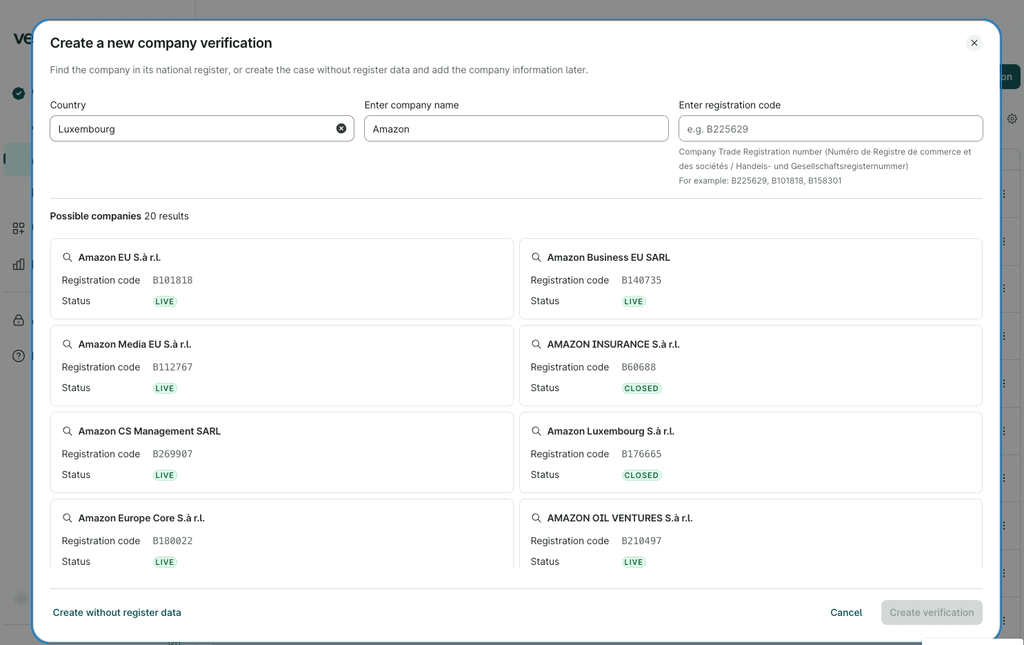
A name search for “Amazon” in Luxembourg in Veriff Business Verification returns a long list of registered entities, some live and some closed. The results are based on business registry data, and not every entity with “Amazon” in its name belongs to the Amazon group. Amazon is used here as a well-known example of a brand operating through several registered entities in one country. Amazon is not a Veriff customer and is not affiliated with, and has not endorsed, Veriff or this content.
Trading names add another layer. In the United Kingdom, a company can trade under a name it never registers with Companies House, and there’s no public register of trading names. Marketplace store names are close cousins: the shop your customer runs may share very little with the legal name behind it.
Even an exact legal name can slip past a search, thanks to a suffix like GmbH or LLC, an “&” stored as “and”, or a name transliterated from another alphabet. That’s why the registration number remains the better tiebreaker, wherever customers actually know it.
Right country, wrong register
Knowing the country is a great start. It just isn’t always enough, because many countries keep different kinds of businesses in different places.
Poland splits them neatly. Companies sit in the National Court Register (Krajowy Rejestr Sądowy, KRS) and get a 10-digit KRS number. Sole traders sit in a separate register, the Central Register and Information on Economic Activity (CEIDG), and never get a KRS number, so you find them by their tax identification number (NIP) instead. Their names follow different rules too, since a sole trader’s business name has to include the owner’s first name and surname. For extra fun, KRS numbers and NIPs are both 10 digits long.
Germany goes one step further. Many sole traders and small partnerships never enter the commercial register at all, because for them it’s voluntary. They only register with their local trade office (Gewerbeamt). Each municipality keeps its own trade register, and unlike the commercial register, it isn’t public. Getting an extract means applying to the right town, showing a legitimate interest, paying a fee and waiting. A real, trading German business can therefore return zero results in a business registry search, and that result is correct.
The United States (US) has no national company register at all. Each state runs its own, with its own numbering, and many companies are incorporated in one state while operating in others.
Verify businesses with confidence
Learn how business verification helps you reduce fraud, manage risk, and onboard legitimate businesses with confidence.
Tax IDs: the number everyone actually remembers
Ask a business owner for their company number and there’s a good chance you’ll get their tax ID. It’s on every invoice and every tax return, so it’s the number they know by heart. The catch is that tax IDs live in tax systems, and tax systems don’t share a database with business registries.
We learned this the hard way in the US. Our research showed that European KYB providers typically searched US companies by registration number, so that’s what we expected customers to send. When we started testing, the vast majority of the US numbers customers sent us were tax IDs. Finding the state registration number would have meant digging through company paperwork, which is a lot to ask of someone who just wants to get onboarded.
The number in question is the Employer Identification Number (EIN), issued by the Internal Revenue Service (IRS). Company registration happens at state level, the two systems aren’t connected, and not every state publishes the EIN. There’s no public IRS lookup either, only a program that confirms a name and number pair you already have. No wonder very few data providers offer company search by tax ID. For US companies, the legal name and the state where the company is registered are usually the better way in.
Europe has its own version of the problem. Across the European Union (EU), VAT numbers can be checked in the VAT Information Exchange System (VIES), but many small businesses, like the German sole trader from earlier, never get one.
Can’t find the company? Six common reasons
An empty search result feels like a dead end, but it usually has a very specific cause. Spot the pattern and you know what to ask the customer for next, or that the empty result is the right answer.
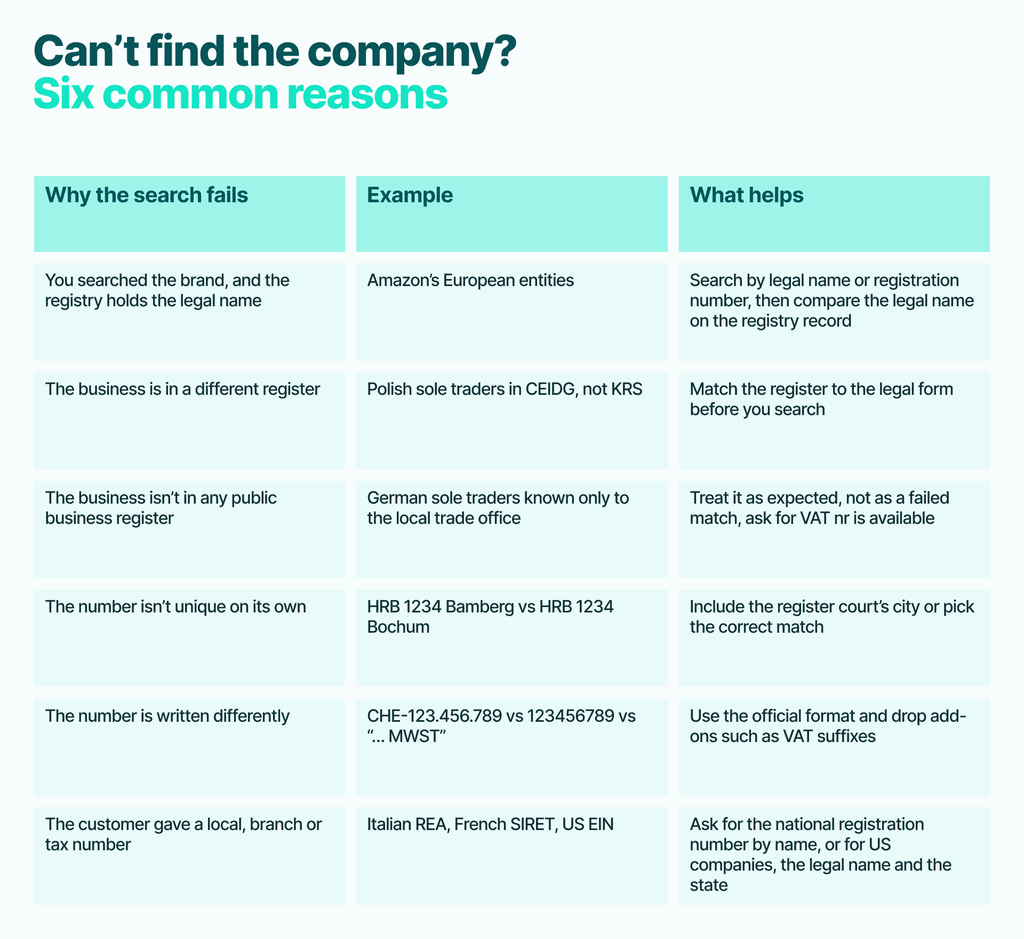
Most of these are fixed by asking a better question at the start of onboarding. Ask for the country first, and the state or register where it matters. Ask for the national registration number by its local name, show an example of its format, and tell people where to find it. German companies, for instance, must print their register court and number on business letters, invoices included.
And when the business genuinely isn’t in a public register, the search doesn’t have to be the end of the journey. In Veriff Business Verification, you can create the case without register data, and the business can enter its details itself and upload documents that show it exists.
Where Veriff Business Verification fits
Every example in this post comes back to the same principle: the official business registry is where the truth about a company lives. Veriff Business Verification is built on that principle. It uses official business registries and trusted data partners across 300+ jurisdictions, so once you’ve found the right company, you’re working with registry data, with the source shown in every case.
Finding the company is also only the first step of KYB. Where the registry provides them, Veriff Business Verification shows the company’s directors, shareholders and ultimate beneficial owners (UBOs), and you can verify their identity with Veriff identity verification.
The right number, in the right registry
Most failed company searches come down to a mismatch between what the customer knows and what the registry expects, such as a brand instead of a legal name, or a tax ID instead of a registration number. Once you know the patterns, you can ask for the right input up front and spot the cases where an empty result is simply correct.
The right company is usually one good number away. It just has to be the right number, from the right registry.