Login
 Help Center
 How to get verified


Blog Post
Why unstructured document verification matters: The hidden fraud risk
A fraudster no longer needs Photoshop skills to fool your compliance team. They just need a prompt.
Generative AI can create convincing bank statements in seconds, making traditional fraud indicators harder to spot. As document manipulation becomes easier, verifying the evidence is just as important as verifying the person behind it.
That’s where unstructured document verification comes in.
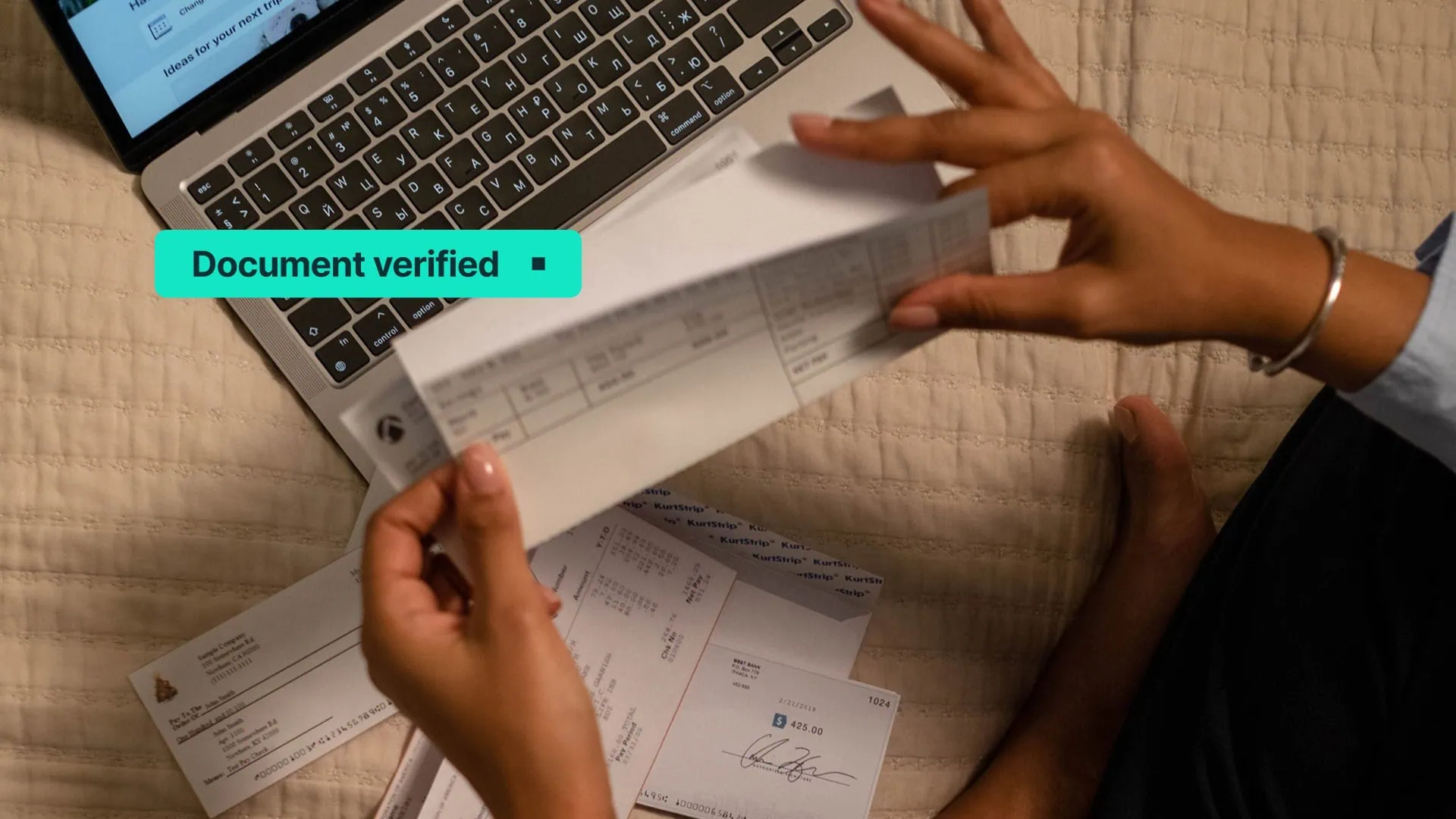
A fraudster no longer needs Photoshop skills to pass your compliance team’s review. They just need a prompt.
Ask your favorite AI tool to generate a bank statement. Within seconds, you’ll have a document complete with the right issuer logo, the right formatting, and transaction histories that look entirely plausible. No typos. No misaligned fonts. No telltale signs that a human reviewer was trained to spot. The silly mistakes that used to give fraud away, such as the stretched logo, an inconsistent font, a suspiciously round balance, are disappearing. AI models have gotten too good.
This shift has exposed a blind spot in identity verification. The industry has spent years hardening how it verifies who someone is, but verifying the evidence they submit, such as a bank statement, utility bill, or signed contract, has lagged behind. That gap is now the easiest way in for fraud, and unstructured document verification was built to close it.
The document fraud problem has changed shape
For most of the past decade, the conversation around identity fraud centered on ID documents: forged passports, manipulated driver’s licenses, printed photos held up to a camera. That threat hasn’t gone away, but it has become harder to execute successfully, because plastic IDs are standardized. Issuing governments and institutions maintain known specimens. Barcodes can be cross-checked against printed data. Every field has an expected format, and deviations are detectable because there’s a ground truth to compare against.
Unstructured documents have no such ground truth.
A bank statement, a lease agreement, a proof-of-address letter. These come from thousands of different issuers, each with their own layout, branding, and formatting conventions. A single country might issue one standardized national ID, but that same country could have thousands of distinct utility bill formats across regional providers. There is no specimen to check against, no barcode to validate, no universal template to model. That variability, which once made these documents merely inconvenient to process, now makes them the path of least resistance for fraud.
And the fraud isn’t limited to swapping out a name or address. Bank statement fraud increasingly happens at the transaction level, fabricated deposits, altered balances, and entries inserted or removed to paint a different financial picture entirely. The document still looks like a bank statement. It still carries the right logo. It just isn’t true.
Why unstructured documents matter for due diligence
As due diligence requirements tighten across regulated industries, ID verification alone is no longer sufficient. Even when an ID includes an address, that single document often can’t carry the weight of full identity and address verification on its own, which is why so many fintechs require a second document to confirm residency. Other use cases still push the requirement: verifying bank account ownership, confirming source of funds, validating tax details against an SSN, or establishing identity in countries where standardized IDs don’t exist or can’t be processed in a usable format.
Supporting documents such as bank statements, utility bills and payslips have moved from edge case to expectation in many verification flows. Regulated businesses need a way to process and validate these documents, and that’s the gap unstructured document verification is designed to fill.
Why manual review can’t keep up
Human review was never sufficient for this problem at scale. Three structural weaknesses make that clear:
Language coverage. Global businesses can’t realistically staff reviewers for every dialect and regional document format a user base might submit. A country like India, with its range of dialects and document variations, illustrates the problem well: most enterprises can’t achieve full in-house coverage, even before considering the quality assurance layer needed to check reviewers’ own output.
Fraud expertise. Spotting a manipulated bank statement requires knowing exactly what to look for, and that expertise is hard to train, harder to scale, and constantly going stale. What counts as a telltale sign of fraud today may be a solved problem for fraudsters tomorrow, because fraud techniques evolve as detection techniques. Keeping a human team’s knowledge current, consistent, and evenly distributed across reviewers is an ongoing operational burden with no natural ceiling.
Speed. Even setting fraud aside, a manual review of document completeness and type can take a human reviewer anywhere from 50 seconds to several minutes, depending on complexity. A contract verifying property or vehicle ownership requires actually reading through the document to locate and interpret the relevant details. That’s a meaningful delay in a user journey where conversion depends on instant decisions.
None of this means manual review has no place. It means manual review alone can no longer carry the weight the threat landscape now demands.
How automated unstructured document verification works
Addressing this gap requires analyzing a document the way a trained specialist would – only faster, and at a scale no team of specialists could sustain. That means operating across three distinct layers simultaneously:
Document structure. Does a bill actually look like a bill? This layer checks for the presence and arrangement of elements a given document type should have – an issuer, a recipient, and relevant details like electricity or gas usage on a utility bill. It’s the first filter for whether a submitted file matches what it claims to be.
Metadata. Every digital file carries a footprint – an editing history, file properties, and other digital indicators that can reveal whether a document has been altered after the fact, even when the visual output looks clean.
Visual structure. This layer examines the document at the pixel level: inconsistent fonts, formatting irregularities, and background context that might indicate “document farming” – the repetitive generation of near-identical fraudulent documents. These are the signals a human eye is increasingly unable to catch, but that a model trained specifically to look for them can.
Classification and extraction work alongside these checks, not apart from them. Classification identifies the document type and issuer. Extraction reads the document in context and pulls the fields needed for verification, such as income figures or issue dates. The tamper check then adds another layer on top, because a correctly classified document can still be fraudulent. All of this takes seconds: automated systems can scan and classify a document in under 10 seconds, compared to 50 seconds to several minutes for a manual review. If a document type isn’t supported, the system can instantly tell the user and suggest accepted alternatives, keeping the verification flow moving.
What happens when a document is flagged
When a document is flagged as potentially tampered with, the end user is never notified directly. This is intentional, and it matters for compliance: alerting a potential fraudster that their document has been detected would undermine Suspicious Activity Reporting (SAR) obligations and give bad actors the chance to adjust their approach.
Instead, the business receives a risk assessment, categorized as High, Medium, or Low, along with the specific indicators that drove that classification. This gives compliance and risk teams full context to decide how to proceed, whether that’s rejecting the submission outright, requesting additional documentation, or escalating to a human reviewer for further investigation. When indicators strongly suggest fraudulent manipulation, the system can act to reject the document and protect the business before the fraud goes any further.
Where human judgment still matters
Automation closes the gap in scale and speed, but it doesn’t replace human expertise. It moves that expertise to where it matters most: edge cases.
A model might flag a document as suspicious because of a pattern that’s actually normal in a certain region. A reviewer with local knowledge can spot that right away, while a model would need specific training to make the same call. This matters even more as document verification expands into Know Your Business (KYB), where reviewing business documents means understanding regional legal language. Terms like “main shareholder” or “legal representative” can mean different things across jurisdictions. Models can learn these nuances over time, but human expertise remains essential for legal and regional judgment calls that have no universal pattern to learn from.
The most effective approach isn’t automation, instead of human review. Automation handles scale, speed, and consistency, so people can focus on the cases that truly need them.
The bottom line
Document fraud is evolving faster than most verification processes. Today’s fraudsters use tools that produce results a human eye can barely catch, so defenses need to work differently: structurally, forensically, and fast enough to keep up with threats that improve every time a new model ships.
ID verification alone was never built to solve this problem, and manual review can’t close the gap on its own. The businesses that get ahead will treat unstructured document verification with the same rigor they’ve long applied to identity.
Learn how Veriff’s unstructured document verification works, and explore the use cases relevant to your business. CTA: https://www.veriff.com/product/intelligent-document-processing