
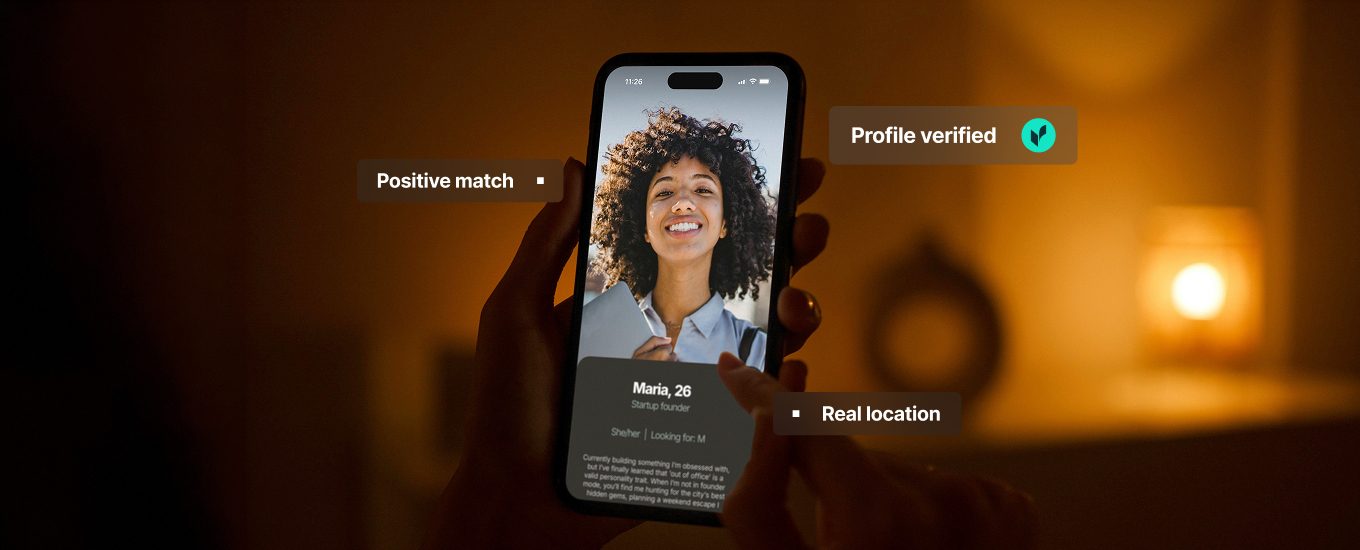
Trust at first swipe
How identity verification drives conversion, retention and safety in modern dating platforms.

Introduction
by Ira Bondar-Mucci, Fraud Platform Lead, Veriff
Dating apps and websites are big business today. More and more of us - about 350 million people worldwide used dating apps in 2025 - are flirting, chatting and falling in love online. The industry was valued at $9.65 billion in 2022, according to Grand View Research, which projects a compound annual growth rate of 7.4% between up to 2030.
The business has also become increasingly sophisticated, appealing to customers worldwide in a range of niches and markets, each with its own characteristics and audience. North America is the largest region by revenue, at more than a third of the overall market, but Asia-Pacific is seeing the fastest growth, expanding at a rate of over 8% every year.

The market’s appeal is not just a matter of money — it’s also the sheer diversity.
Online dating covers anything from general dating sites and apps that serve a broad audience, to specialized providers focused on specific age groups, religions and interests. Others cater to individual countries or wider regions. Each niche brings unique demands and challenges.
Overall, the business is focused on attracting and retaining users, building revenue through subscriptions, advertising, and premium services and features.
But the sector faces all the dangers associated with any online industry, plus a range of unique challenges.
$400 million
In Q3 2025 alone, over 11,200 people reported romance scam losses totalling nearly $400 million, with a median loss of about $2,200
Our very own Veriff Voices podcast featured a revealing interview with Cecilie Fjellhøy, a high-profile victim of fraud featured on “The Tinder Swindler” TV show, which exposed the danger of romance scams, usually where a criminal fakes a romantic relationship to exploit the victim for cash - or worse.
Love bombed: the devastating impact of romance fraud
And it’s not just a financial issue. Companies must ensure their services are not exploited by sexual predators, for instance. They must guard against underage users accessing services that are intended for adults.
So how can online dating services meet customer demands, while protecting them from online dangers? Technological solutions are key. By embracing cutting-edge, automated technology, companies can enhance the customer experience - while keeping them secure.
This report will explore some of these solutions and can provide a helpful guide to ensuring your dating platform - like any good relationship - is one that is built on trust.

Start with the problem
Online dating can bring significant security threats, for both users and platform providers.
But by utilizing market-leading technologies, services can protect themselves and their users, in turn boosting their brand.
Keeping customers safe increases user acquisition and retention and cuts user churn. This can be achieved through age validation solutions; fraud checks; biometric authentication; and in certain cases, fast and easy-to-use IDV.
But knowing which combination of these solutions to utilize first requires knowing what problem you are trying to solve.
Romance scams are a common threat. Typically, this sees fraudsters use fake online profiles with fictional identities, with victims tricked into transferring money or even property. It involves establishing contact; expressing strong emotions and sharing ‘personal’ information; and then asking for money, perhaps to address some kind of fictional emergency.
Criminals adopt multiple approaches. Here are some key examples - and potential solutions.

Catfishing
Catfishing is a significant problem in online dating websites and in dating apps.
It boils down to one key question: am I really talking to the person in the picture? Scammers use other people’s photos, often sourced from social media sites, to lure their victims and conceal their true identity, helping them avoid the consequences of their fraudulent behavior.
What are the risks? Scams like catfishing could make customers distrust your platform. The core business of dating companies is trust, and your reputation helps you stay in business. If there is any question over safety, existing customers will leave, and potential new customers will stay away.
How can you fight back? With Veriff’s technology, users are asked to take a live selfie to confirm their ‘liveness’ when they enrol. Their uploaded images are then compared to the verified selfie, ensuring these images look the same.
User privacy is essential. The verified, real facial image is not shown on the site, protecting their privacy; it is only used in that moment as evidence of liveness and as a reference.
Bots and Beyond
It is vital for dating apps and platforms to enable by assuring users are real and that the images they are using are their own.
This is important to prevent different types of scams, including the fake accounts that can pose a risk in catfishing and more. But it is also vital in preventing the sort of deception that will alienate users and drive them away from the platform. Put simply, genuine users want to make genuine connections with other genuine people - so if your app or site is populated with fake accounts then users will quickly lose interest and move elsewhere to meet their needs.
Bot accounts take this threat to the next level, with advances in AI language models lending a new degree of sophistication to this danger. It is critical that dating apps and platforms do all they can to ensure only genuine users are able to open accounts.
Talk to one of our fraud experts, or scroll on to get more global fraud data


“A lot of the support tickets around ‘there’s a lot of fake profiles’ dropped pretty much about a month after we started verifying. Our trust and safety score increased by 25 percent since we launched verification,”
Lavina Lim
Product Lead, Core Experience, Feeld

Feeld is a dating app built for people who want space to explore relationships, intimacy, and identity outside traditional norms. Its origins, community ethos, and product design all center on providing a safe and expressive environment for people across queer, kink, and ethically non-monogamous communities. As a company, Feeld considers itself a community of communities and aims to provide members with the tools and protection they need to be fully themselves while connecting with others who share similar values.
Across the dating industry, identity misrepresentation has long fueled issues such as catfishing, romance scams and general distrust between users. Feeld’s diverse community, which includes many people who rely heavily on discretion and safety, felt these issues acutely. The company had previously attempted manual verification processes, but these were time consuming and unsustainable for a small, self-funded team. Feeld needed a scalable way to confirm that members were who they claimed to be, without compromising the privacy needs of people for whom anonymity or partial anonymity is essential.
Since launching verification, Feeld has seen measurable improvements across user safety, trust signals, and operational efficiency. Verification adoption has increased consistently, with members responding positively to the added security and transparency.
The presence of more verified profiles also quickly reduced concerns about fake users.
CASE STUDY
Veriff & Feeld
Feeld and Veriff partnered to fight fraud and build a dating platform where trusted interactions and user safety are paramount.


The company had previously attempted manual verification processes, but these were time consuming and unsustainable for a small, self-funded team.
Veriff and Feeld: Building trust with a leading online dating platform

The tools to create a safe and trusted environment
There are a number of tools available to dating apps and platforms that serve to keep users secure.
Protect their data, and create the foundation for trusted connections to take place.
For example, age validation techniques could prove if a person is above a defined age, while liveness assurance could establish that they are a real person and not a bot. And biometric authentication can help prove that a person is who they say they are..
And, if getting users to present documents feels too intrusive or an obstacle to conversion, then there is also Veriff's Age Estimation solution, which uses facial biometric analysis and advanced AI algorithms to estimate a customer's age without requiring the customer to provide an identity document or credit card.
Ultimately, though, ensuring your users are genuine comes down to answering three key questions:
Is this person real at the moment of signing up for an account?
Is this person trusted - are they a potential fraud risk or are they a high-value customer?
Is this still the same real and trusted person logging in throughout the lifetime of that account?
Veriff is uniquely placed because we have the ability to provide dating platforms positive answers to these three questions. The dating apps we work with deploy a process known as ‘selfie verification’, which ensures uploaded images match a person’s real, verified face. This confirms identity through a live photo or video, before comparing all subsequent images that have a face to the verified image. This is key to addressing the scourge of fraudulent accounts.
Veriff’s process involves a simple selfie, with results on liveness delivered within a second. The technology also uses biometric authentication, with all uploaded images checked against the verified face to confirm a match - or not. This can also be used every time there’s a new login, ensuring the same person is accessing the account.
Identity verification
Identity verification (IDV) is not legally required in online dating, as it is in other more heavily regulated industries, but it is still a great method of building a trusted user base for dating platforms.
Veriff’s identity verification solution is an AI-powered, automated platform that confirms user identities in real-time by analyzing documents and biometric data. It provides secure, fast onboarding using AI to detect fraud, match selfies to IDs, and ensure regulatory compliance.
It is proven to deliver speed, convenience, and low friction for your users resulting in high conversion rates, fraud mitigation, and operational efficiency for your business.
And these are some of the tools we use to do this:
Biometric Authentication
Veriff's biometric authentication is a fast, AI-powered, facial recognition solution that allows users to verify their identity in seconds by taking a selfie.Once the user’s selfie has been enrolled, either from an identity verification session or by taking a biometric enrollment selfie, the user can simply use their face to authenticate themselves.
It matches live, passive liveness-checked, and analyzed selfies against previously stored data to prevent fraud, secure accounts, and enable passwordless login.
This fast and fully automated process can be integrated into any stage of the user journey such as account access, high-risk activities, or account recovery.
Users can authenticate on any device and platform of their choice, as Veriff supports iOS, Android, mobile web, and web SDK or API.
Age assurance
Veriff can help online dating providers ensure that they are keeping their users safe, and promoting trust across their platforms. This means keeping fake profiles, bots, underage users, and repeat offenders off the platform, while remaining compliant with global age verification requirements.
The right Age Verification approach ensures that only age-appropriate users can access your services. How does it work? Veriff has two options for safely ensuring the age of your end-users; Age Validation and Age Estimation.
Choosing the right Age Verification solution
Choosing the most suitable Age Verification solution for your business means balancing the level of age assurance required with the potential friction presented to your users. While Age Validation provides a definitive answer as to an end-user’s age, that user may not always be comfortable submitting an identity document to your business.
Age Validation
Veriff’s Age Validation solution allows you to confirm the age of your users by using the extracted date of birth from a user’s submitted identity document. Users under your defined age threshold can be automatically declined. This solution requires that your end-users submit an identity document, which may not always be suitable or desirable, but it provides a definitive answer as to their age.
Age Estimation
Veriff’s Age Estimation solution uses facial biometric analysis and advanced AI algorithms to estimate a user’s age without requiring the user to provide an identity document. While this solution only provides an estimate, it is highly accurate and only requires that the user take a selfie image.
Want to discover how Veriff can help you combat online fraud?


Executive summary
Address the security threat
Online dating customers are vulnerable to catfishing, romance scams and more. Biometric authentication can prove someone is who they claim to be, adding a new layer of safety and security.
Ensure age validation
It is vital that your customers are 18 or another pre-defined legal age to use your services; this not only safeguards users, but helps maintain your brand reputation. Veriff’s age validation technology ensures people are the age they claim to be, automatically extracting the date of birth from government ID.

Respect user privacy
The type of identity verification software used in other sectors may not be appropriate in online dating, where users often want privacy due to cultural or legal concerns, among other reasons. Tools like Veriff’s Age Estimation solution can determine someone’s age using just a selfie without demanding their data.
Safe customers are happy customers
The types of verification tools outlined in this paper satisfy much more than legal demands. They give your customers a secure experience, making them more likely to stick around. Dating is tough enough - by boosting customer security, you will also support the future growth of your platform.
Learn more
We have plenty of resources available for you to learn more about fraud, and how to protect your business.
About Veriff
Veriff is a global identity platform helping businesses build trust online. Our AI-native technology combines automation and human expertise to quickly and accurately verify users worldwide with minimal friction.
Our trust infrastructure helps businesses stay compliant, prevent fraud, protect users, and scale globally, enabling a safer, more transparent internet for everyone.

Trusted by 4,000+ companies






Speak to one of our fraud experts today to discover how we can create customizable fraud protection for your business.